



LifeStance Health is a mental healthcare network that connects you with psychiatrists, psychologists, and licensed therapists across both in-person clinics and virtual formats.
The platform focuses on structured mental health support, covering conditions such as anxiety, depression, ADHD, and personality disorders, while offering therapy, medication management, and psychological evaluations.
In this review, we assess how the platform performs across provider matching, care continuity, service depth, and accessibility. The review also compares the platform against similar telehealth platforms operating in the hybrid mental healthcare space.
LifeStance Health is built around integrated, insurance-supported care delivered through both virtual and limited in-person care formats. As per its official website, the platform features clinicians supporting broader access to different mental health specialties within a single ecosystem.
Service coverage is structured to address both common and complex mental health conditions. Core areas include therapy and psychiatric care for conditions such as anxiety, bipolar disorder, PTSD, and personality disorders, alongside specialized support like psychological testing, neuropsychological evaluations, and medication management. It also provides advanced services such as Transcranial Magnetic Stimulation and Spravato-based therapy, indicating a focus on cases that may require more than standard talk therapy. The care model emphasizes personalization and coordination. You are matched with clinicians based on preferences, condition, and insurance compatibility.
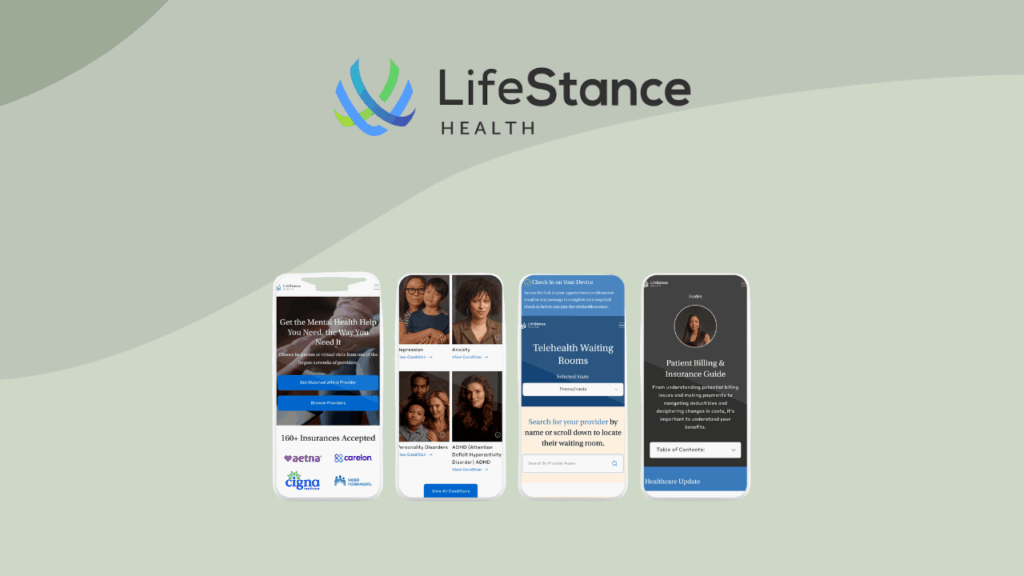
LifeStance Health gives access to therapy and counseling services that include cognitive behavioral therapy, psychodynamic therapy, exposure therapy, EMDR, somatic therapy, and acceptance and commitment therapy. Formats like individual, group, family, and couples sessions are also covered. These services may provide support for conditions such as anxiety, depression, ADHD, trauma-related concerns, eating disorders, and postpartum mental health changes. Additional formats like art therapy, play therapy, and parent-child interaction therapy are used particularly for children, where non-verbal expression and behavioral interaction play a key role in emotional development. Therapy is available through both in-person sessions and online formats, allowing you to engage in structured psychological support based on your needs and preferences.
These approaches work by targeting how thoughts, emotions, and behaviors are processed and reinforced in the brain. For example, cognitive behavioral therapy or CBT focuses on identifying and restructuring repetitive thought patterns that can influence stress responses and decision-making. Exposure therapy gradually reduces fear responses by retraining how the brain reacts to perceived threats.
The psychiatry services offered by LifeStance Health include adult psychiatry and child and adolescent psychiatry, delivered through in-person and online appointments. You work with psychiatrists or psychiatric mental health nurse practitioners who evaluate symptoms, medical history, and behavioral patterns to determine whether medication is appropriate.
Adult services focus on conditions such as anxiety, depression, bipolar disorder, and psychotic disorders. Meanwhile, child and adolescent psychiatry considers additional factors like developmental stage, family dynamics, and educational environment. These services also extend to obsessive-compulsive disorder, post-traumatic stress disorder, eating disorders, and ADHD. They help by identifying patterns in the brain and behavior that may be disrupting daily functioning and then aligning procedures accordingly.
The psychological testing and assessment services cover neuropsychological testing and evaluation, as well as psychological testing and evaluation. Neuropsychological testing focuses on understanding how brain structure and function influence cognitive abilities, behavior, and emotional responses. Meanwhile, psychological testing examines patterns in thoughts, mood, personality, and overall mental health.
These evaluations are conducted by licensed doctoral-level psychologists using standardized, research-based tools and may include measures of intelligence, attention, memory, emotional state, personality, and academic skills.
These services help clarify whether symptoms are linked to mental health conditions, developmental differences, or underlying medical or neurological factors. For example, variations in attention, memory, or processing speed can reflect how efficiently different brain pathways are functioning, while emotional and personality assessments can highlight how stress or mood changes influence behavior.
The specialty approaches include targeted interventions designed for complex mental health conditions. These options include ketamine therapy, Spravato® (intranasal esketamine), and transcranial magnetic stimulation (TMS). The platform also gives access to structured approaches like EMDR therapy, somatic therapy, and neurosequential model-based care for trauma. Some of these plans are delivered in-office under clinical supervision due to safety requirements, while others can be integrated into remote support depending on the method used.
These approaches work by targeting brain function and response patterns more directly than standard therapy alone. For example, ketamine or esketamine influences glutamate pathways, which are involved in neural communication and adaptability, potentially affecting how the brain processes mood and stress signals. TMS uses magnetic pulses that stimulate specific brain regions linked to mood regulation, aiming to adjust neural activity patterns associated with persistent depression.
LifeStance Health reports operating across 33 states, with approximately 550+ centers and nearly 8,000 clinicians. This scale primarily affects how easily you can access care and how many provider options are available to you within a single system.
As these services are integrated, your therapist, psychiatrist, and any testing specialist can access shared records. If you move between services, your clinical information carries over, which reduces repetition and helps maintain continuity when combining therapy, medication management, and testing. If a provider is not a good fit, you can transfer to another clinician within the network without repeating the full intake process or re-verifying insurance.
The clinician network includes a range of specialties within the same organization. Erica Kalkut focuses on neuropsychological evaluations and cognitive testing, Andrew Buchholz provides psychiatric care and medication management, and Bryan Matson specializes in EMDR therapy for trauma. Some locations also offer Transcranial Magnetic Stimulation (TMS) and Spravato. The larger clinician network mainly affects access, coordination, and flexibility, allowing you to start care, adjust providers, and use different services within a single system.
LifeStance Health claims to offer a hybrid care model with in-person appointments and virtual visits. On its official site, the company states you can choose office visits at its centers or telehealth sessions based on provider availability, location, and personal preference.
Its telehealth platform supports therapy, psychiatry, and medication management with eligible providers. This may help you continue care during travel, relocation within covered states, or times when easier scheduling matters. This hybrid model may give you more control over how you receive care. You may choose in-person visits when direct interaction matters, use virtual sessions when convenience matters, and access treatment through insurance-supported options.
LifeStance Health operates within insurance networks, which introduces variability you have to manage directly. Coverage depends on payer contracts, reimbursement rates, credentialing timelines, and network rules that can change, so access is not consistent across all providers, specialties, or locations.
Even if your insurance is listed as accepted, your specific clinician may not be in-network. Some providers may still be in credentialing, which can take around 60–120 days. During that time, they may not be able to bill insurance, even if they appear available. There have also been reported mismatches in some markets with carriers like Anthem and Blue Cross Blue Shield.
Copays can range from about $22 to over $45. If you are paying out of pocket, pricing is given as a range. For example, psychiatry in some states is estimated at around $249–$560, so final costs are not fully clear upfront. This can affect your options. If your provider is out-of-network or not fully credentialed, you may need to switch clinicians, wait, or pay higher rates. You also need to confirm network status before appointments to avoid unexpected charges.
Talkspace and LifeStance Health differ in how care is accessed and delivered. As per their official website, Talkspace operates as a fully virtual platform where therapy is available through live video, voice, live chat, and continuous messaging, allowing you to receive care from anywhere without commuting or scheduling constraints. On the other hand, LifeStance offers both in-person and virtual visits, giving you the option to attend physical clinics or use telehealth depending on what fits your situation.
The communication model further separates the two. Talkspace provides unlimited messaging therapy with 24/7 access, where you can send text, audio, picture, or video messages at any time and receive responses daily (five days a week). This is combined with live sessions and tools like Talkcast, personalized podcasts for between-session support. LifeStance, on the other hand, follows a structured appointment-based system where therapy, whether individual, couples, family, or group, is delivered during scheduled sessions. While it offers online therapy services, it does not highlight continuous messaging or real-time asynchronous communication as part of the care model. Speed and onboarding also show a contrast. Talkspace allows you to check insurance eligibility in minutes, answer a few questions, and get matched with a licensed therapist within about two days or sooner. If the initial match doesn’t work, you can switch therapists at no additional cost. Meanwhile, LifeStance focuses on guiding you through selecting your state, verifying insurance, finding a clinician, and then booking an appointment, but it does not emphasize rapid matching timelines or free provider switching in the same way.
Their plan scope also differs in emphasis. Talkspace highlights accessible, category-based therapy such as individual therapy (18+), teen therapy (13–17), couples therapy, and specialized support through programs like Chapters. It also covers over 150 conditions, including anxiety, depression, OCD, trauma, and eating disorders. In comparison, LifeStance provides a broader clinical range that includes adult psychiatry, child and adolescent psychiatry, neuropsychological testing, psychological assessments, and personality disorders. Both platforms integrate therapy and psychiatry, but the delivery differs. Talkspace claims to connect you with an online psychiatric provider within about a week for evaluation, prescription, and ongoing medication management. LifeStance offers psychiatric medication management as part of a personalized care plan, often combined with testing, evaluations, and coordinated clinical oversight, which may include both in-person and telehealth interactions.
Insurance coverage and pricing structures also diverge. Talkspace is in-network with major providers like Aetna, Cigna, Optum, Anthem, TRICARE, and Medicare, and claims that insured members have a $0 copay, with average copays around $15, depending on the plan. It also supports out-of-pocket plans starting at $69 per week. On the other hand, LifeStance accepts over 290 insurance plans, such as Blue Cross Blue Shield, UnitedHealthcare, and Medicare/Medicaid options. However, it highlights that most copays range from $22 to $36, with additional costs such as deductibles or coinsurance depending on the plan.
Talkiatry operates a 100% virtual model where every visit is conducted online, removing the need for commuting or waiting rooms. It emphasizes speed and convenience, allowing you to get matched with a psychiatrist in minutes after a short assessment and typically schedule appointments within days, with availability across 45 states. LifeStance, on the other hand, combines telehealth with in-person care through approximately 550 centers nationwide, giving you the flexibility to choose your format. The scope of services highlights a clear structural contrast.
Talkiatry focuses on psychiatry, where clinicians assess symptoms, prescribe medication, and may recommend therapy either through their own therapists or external specialists. Its model keeps care centered on psychiatric evaluation and procedure planning. On the other hand, LifeStance extends far beyond this by offering services, including adult and child psychiatry, psychological and neuropsychological testing, and specialty support such as TMS, EMDR, and Spravato. This allows you to access multiple types of care within one system instead of coordinating across different providers.
Provider scale and composition further differentiate the two. Talkiatry employs and vets its own psychiatrists within a structured practice model. It highlights clinicians averaging 10 years of clinical experience, covering 26 subspecialties, speaking more than 30 languages, and being fully licensed to prescribe. Meanwhile, LifeStance operates at a significantly larger scale with highly trained clinicians across disciplines, including psychiatrists, psychologists, and licensed therapists, all working under internal clinical quality standards set by a centralized leadership team.
Access and matching approaches also differ in execution. Talkiatry uses a guided matching system where you share your needs, review psychiatrist profiles, and book directly. On the other hand, LifeStance also offers provider matching but adds more options, such as specialty, insurance, and visit type, supported by a large provider directory.
Both platforms address a broad set of mental health conditions, including ADHD, anxiety, depression, bipolar disorder, PTSD, OCD, insomnia, postpartum concerns, and substance use disorder. Talkiatry covers these through psychiatric evaluation and medication management, with support tailored to individual needs. LifeStance expands into additional areas such as schizophrenia, personality disorders, and oppositional defiant disorder, supported by in-house testing and specialized programs.
In assessing LifeStance Health, we looked at the brand’s operational history, scale of operations, and ratings across independent review forums.
The Better Business Bureau accredits the brand and holds an A+ rating, which supports a baseline level of business credibility and formal complaint handling standards. However, BBB review data shows mixed real-world experiences.
Positive feedback points to easy appointment booking, quick access to providers, and supportive care during sessions. However, there are concerns around billing and communication. Some reports mention insurance claims not being processed on time, unexpected charges, and accounts being sent to collections without clear notice.
As per the available data, the brand presents a mixed credibility profile, as repeated concerns around billing accuracy and communication reduce consistency in experience.
To evaluate LifeStance Health, we analyzed the brand’s real user experiences on Trustpilot, with regard to its range of services, onboarding, provider availability, and brand reliability. On Trustpilot, the platform carries a 3.9 out of 5 score based on over 1890 reviews.
Many users shared positive experiences around individual providers, where sessions are described as attentive, supportive, and structured in a way that helps build comfort over time. Several users noted that certain therapists and psychiatric providers listen carefully, offer clear guidance, and create a sense of continuity in care.
However, some users described issues with appointment management, including bookings that were not honored, repeated last-minute cancellations, or pressure to switch from in-person to virtual care without clear upfront communication. A few also reported difficulty navigating the platform’s systems, such as check-in errors, locked accounts due to minor input mistakes, and limited ability to reach support outside automated channels.
The available feedback indicates that care quality may depend heavily on the individual provider, while administrative processes and communication standards remain areas where expectations are not always met.
LifeStance centers on continuity of care, insurance compatibility, and provider matching, allowing you to engage in ongoing procedures across different specialties.
At the same time, the quality of care can depend on how services are delivered at the provider level. Short, quick medication-management visits may limit the depth of assessment and follow-up typically recommended for monitoring plan response and side effects.
LifeStance primarily operates through scheduled, office-based care and does not work as a 24/7 crisis service, which may require you to seek external support during acute situations. When considering the platform and its services, it is important to maintain consistent follow-ups, monitor changes in symptoms, and clarify how care is coordinated between providers.
Make sure to confirm how prescription adjustments are handled, whether follow-up intervals align with your condition, and how easily you can switch providers if the fit is not appropriate. It also helps to verify insurance coverage details in advance, understand cancellation or rescheduling policies, and keep records of your history to ensure continuity across providers.

Contact us at [email protected] or follow @leafsnap on Twitter! View our Privacy Policy.