

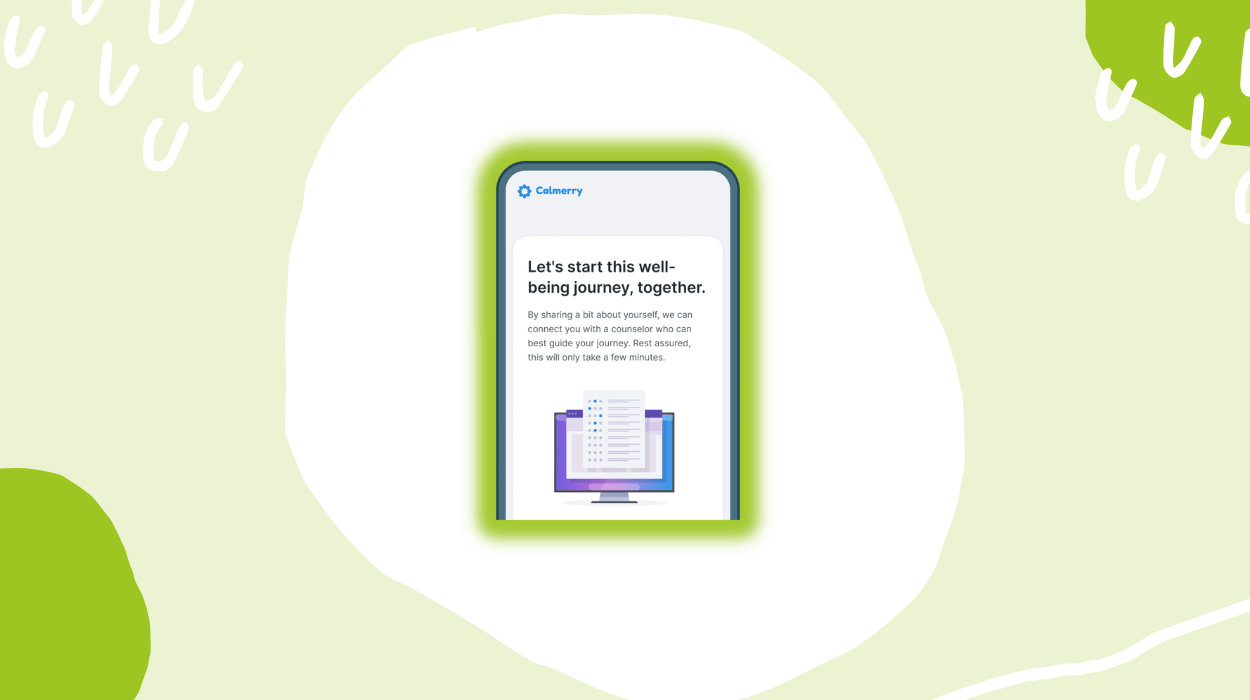

Calmerry is an online mental health platform that provides convenient access to professional therapy and counseling through digital channels.
The brand offers text-based therapy, live video sessions, and self-help resources to provide support for anxiety, depression, relationship difficulties, and low self-esteem. It aims to help you and organizations find support that fits your needs, preferences, and lifestyles.
In this review, we will explore the range of mental health services and resources the platform offers, along with its key advantages and potential limitations. We will also examine user experiences, feedback, and the brand’s reputation to provide a clearer understanding of its service quality, accessibility, and value.
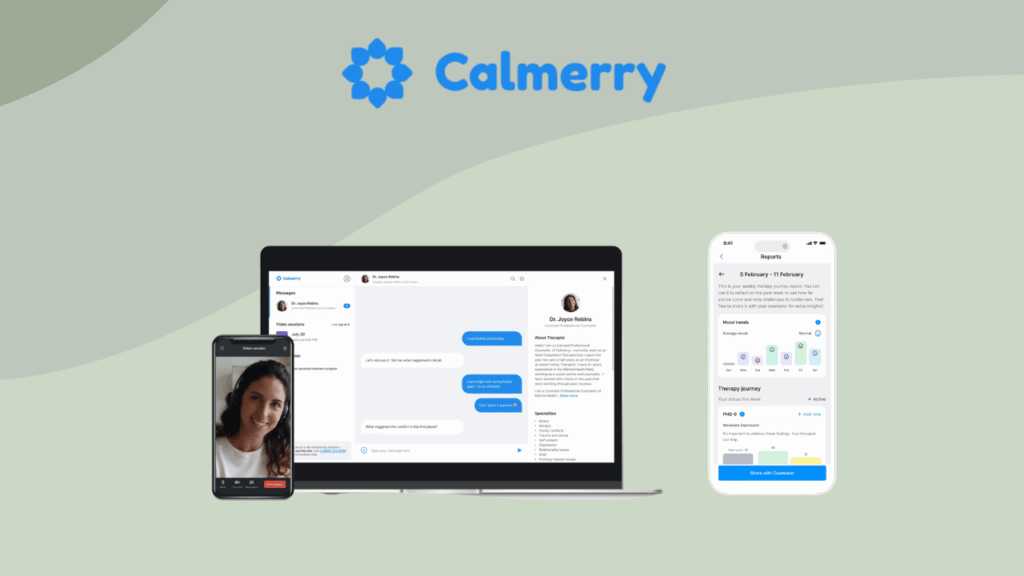
Calmerry offers specialized counseling, self-help resources, and workplace wellness options. Its services cover areas such as addiction, men’s mental health, and obsessive-compulsive disorder (OCD), addressing a range of personal and psychological needs.
Alongside therapy, the platform also provides tools for managing mental well-being independently. These include a daily mood tracker, guided journaling exercises across 10 topics, and mental health assessments.
As per the official website, it reports a network of more than 1,000 licensed mental health professionals, with therapist matching designed to connect you with a suitable provider within 24 hours.
Primary offerings include therapy for depression, anxiety, and obsessive-compulsive disorder (OCD), alongside specialized counseling for men’s mental health, relationships, self-esteem, grief, maternal mental health, and addiction. These services address a range of emotional, psychological, interpersonal, and life-related challenges.
The platform offers text therapy and video therapy, including 60-minute video sessions, allowing you to choose between written communication and real-time virtual consultations. Its therapy approach may combine evidence-based methods such as Cognitive Behavioral Therapy (CBT) and exposure therapy, particularly for anxiety and depression. The platform also provides online mental health assessments for depression, anxiety, relationships, self-esteem, life satisfaction, burnout, ADHD, and OCD. These tools offer preliminary insights into emotional well-being but do not replace professional diagnosis. As per the official website, its service model includes an initial survey to understand your needs, therapist matching, personalized therapy planning, and progress tracking.
Calmerry connects you with a network of more than 1,000 licensed mental health professionals, including clinical social workers, professional counselors, marriage and family therapists, and clinical psychologists. It uses your intake questionnaire to match you with a vetted professional licensed in your state, so you don’t have to search through therapist profiles yourself.
This matching process can make getting started with online therapy easier, especially when you’re unsure which type of therapist best suits your needs. It gives you access to qualified professionals while providing the flexibility to find a therapist who better aligns with your mental health goals.
Calmerry offers four subscription plans that differ in the balance between written communication and live video sessions. The Messaging plan is designed for ongoing text-based communication, with unlimited messaging and counselor responses advertised five days per week. Its 4 Live Videos plan provides four 30-minute video sessions per month, while the two combined plans pair unlimited messaging with either two or four 30-minute video sessions monthly. The service lets you choose between written exchanges, scheduled video consultations, or both, depending on how you prefer to communicate with your counselor and how often you want live sessions.
Calmerry extends the therapy experience by providing you with a daily mood tracker, guided journaling prompts, and a library of over 100 self-therapy resources. These features allow you to reflect on your emotions, recognize recurring patterns in your mood, and explore practical ways to manage everyday stress between conversations with your therapist. Having these resources available within the same platform makes it easier to build consistent self-reflection habits and engage with your mental well-being at your own pace.
Calmerry limits live video therapy sessions to 30 minutes, which can leave limited time to discuss several concerns, explore recurring patterns, or work through emotionally complex topics. When multiple issues need attention, you may have to prioritize certain discussions or leave some questions for a later appointment.
Compared with similar platforms, Calmerry offers shorter live sessions. Brightside Health offers 55-minute standard follow-up sessions, while Rula schedules appointments in 60-minute blocks, with approximately 50 to 53 minutes of direct interaction. These longer sessions provide more time to explore concerns in depth within a single appointment.
You may need additional appointments to discuss issues that could be covered in a single, longer session, increasing the time required to address your concerns.
Rula combines therapy with psychiatry, medication management, and access to in-person appointments. It also emphasizes insurance coverage and lets you choose a provider. Calmerry keeps the process online, with therapist matching and a choice of text messaging, video sessions, or a combination of both.
The plan's cost may make that decision easier. Rula reports an average session cost of $15 with insurance and says it participates in more than 120 insurance plans nationwide. These include Blue Cross Blue Shield, Anthem, Aetna, Cigna, Medicare, and Kaiser Permanente. You can request an instant cost estimate, and Rula verifies coverage before the first appointment. This helps establish expected out-of-pocket costs before the plan begins, although the final amount depends on individual benefits. Calmerry takes a subscription-based approach, with plans starting at $50 per week. Unlike Rula, it does not accept insurance directly. However, the company says its subscription prices are comparable to the copays of most insurance plans. You can also request a receipt and submit it to your insurance provider for possible partial or full reimbursement, depending on your coverage.
Choosing a therapist also involves different levels of involvement. Rula reports more than 23,000 licensed providers and lets you search using your ZIP code and insurance details. You can browse biographies and select an in-network clinician. It says appointments may be available as soon as the following day, depending on provider availability.
Calmerry's network includes more than 1,000 licensed mental health professionals. Instead of starting with a directory, you can complete a 10-minute mental health survey when new, with a therapist match reportedly provided in about one hour. After matching, the therapist is expected to respond within one business day to establish plan goals. This approach reduces the need to browse profiles and make the initial selection yourself, although the match itself does not mean a therapy appointment will happen within an hour.
Rula’s scope covers concerns such as anxiety, depression, ADHD, autism, PTSD, OCD, bipolar disorder, and trauma. It highlights individual, couples, family, child, and teen therapy, as well as psychiatry and medication management. The brand also lists approaches such as Acceptance and Commitment Therapy (ACT), attachment-based therapy, Christian counseling, and Child & Parent Psychotherapy.
Calmerry's specialties include many of the same concerns, from anxiety, depression, PTSD, and OCD to grief, eating disorders, relationship difficulties, and low self-esteem. It also offers addiction counseling, anxiety therapy, depression therapy, and self-esteem counseling.
Rula explicitly combines therapy with psychiatric care, while Calmerry focuses on online counseling. Your choice will depend on the type of support you need and how you prefer to access it.
Brightside combines therapy, psychiatry, medication management, and ongoing progress monitoring into one service. Calmerry concentrates on online counseling, with licensed therapists available through private messaging and live video sessions.
As per its official website, Brightside accepts most major insurance plans, including Medicare and Medicaid, and lists Aetna, Cigna, Anthem, and Ambetter among its providers. The company reports that its insurance network covers more than 180 million people nationwide. Your actual cost will depend on your benefits, including any deductible or coinsurance. Calmerry does not accept insurance directly. The company says its prices are comparable to the copays of most insurance plans. You can also request a receipt for possible partial or full reimbursement from your insurer, depending on your coverage.
Brightside offers a free assessment that helps determine whether therapy, psychiatry, or both may suit your needs. You are paired with a dedicated provider who serves as your main point of contact throughout the plan. Calmerry also begins with an assessment, but the next steps involve selecting a subscription and matching with a therapist. Its network includes licensed clinical psychologists, clinical social workers (LCSWs/LMSWs), and licensed professional counselors (LPCs), with master's or doctoral degrees.
What happens after the first appointment further separates the services. Brightside combines one-to-one video sessions and anytime provider messaging with interactive lessons and weekly symptom check-ins. Providers use those check-ins to monitor progress and adjust the plan or medication when needed. Initial psychiatry and therapy appointments typically last 30 minutes, while therapy follow-ups last 55 minutes and generally occur weekly.
Calmerry offers messaging on any day, scheduled video sessions, and activities such as worksheets and guided journaling where appropriate. It also provides 24/7 human-operated customer support. It does not describe an equivalent weekly symptom-monitoring system, so the two platforms differ in how explicitly they structure progress tracking between appointments.
Brightside also offers several services beyond general therapy. Its range includes psychiatry, Teen Care, and Intensive Outpatient services. Psychiatric providers analyze more than 100 data points to help identify medication options that may be effective and tolerable. Teen Care supports adolescents aged 13 and above with concerns such as anxiety, school pressure, friendships, and self-esteem, with psychiatry available when appropriate.
Calmerry's services center on individual counseling, text therapy, video chat therapy, addiction counseling, and support for depression, anxiety, OCD, and low self-esteem. Its specialties also include panic and stress-related concerns, grief, chronic illness, childhood and emotional abuse, and LGBTQIA+-related support.
As per their official website, Brightside features multiple forms of clinical care under one service, while Calmerry focuses on flexible online counseling.
To evaluate Calmerry, we looked for platforms like Trustpilot to learn about what users have shared regarding their experience. At the time of writing this review, the brand has received a 3.9 rating based on more than 40 reviews on Trustpilot. Many users have highlighted the convenience of online therapy, helpful therapists, flexible communication, and improvements in managing personal challenges.
However, some reported being charged despite missed or cancelled appointments, experiencing delays in receiving refunds, or having to contact customer support repeatedly before their issues were resolved. One user described difficulties cancelling a subscription before beginning therapy, while another reported waiting several months for a refund after experiencing problems with their therapist.
Based on our evaluation, this service appears to be legitimate, though recurring customer complaints raise concerns about the consistency of its online therapy experience.
Calmerry lets you access therapy through messaging, video sessions, or a mix of both. Its therapist-matching process and self-help tools can make getting started easier and give you ways to work on your mental well-being between sessions.
However, its live video sessions are limited to 30 minutes, which may not feel like enough time when you have a lot to discuss. Reports of delayed responses from therapists, cancelled appointments, and difficulties getting refunds also raise concerns about how reliably the service meets your expectations.
Before signing up, think about how much time you need with a therapist and whether the subscription cost is worth it for you. The brand gives you the convenience of online therapy, but make sure its session length and level of support meet your needs before committing to a subscription.

Contact us at [email protected] or follow @leafsnap on Twitter! View our Privacy Policy.