



Tempdrop focuses on wearable fertility tracking and menstrual cycle monitoring through a sensor-based system and companion mobile app. The platform supports ovulation tracking, fertility awareness, and conception planning. It combines cycle charting tools, fertility insights, sleep tracking, and educational resources within a single ecosystem. However, are the brand’s predictions accurate and reliable?
This review will examine the brand’s fertility tracking approach, wearable technology, app experience, and real user experiences. It also discusses the advantages and potential limitations of the brand.
Launched in 2014, Tempdrop positions itself in the women’s health and fertility awareness space, focusing on science-based cycle tracking and data-driven reproductive health monitoring.
The platform’s wearable fertility sensors employ continuous overnight temperature monitoring along with patented filtering and learning algorithms, intended to reduce disruptions caused by irregular sleep patterns or changing schedules. It further highlights zero radiation during sleep, downloadable data access, and cloud-based temperature history storage.
According to its official website, the brand’s Tempdrop 2.0 sensor is FDA registered and CE marked, while the device itself uses medical-grade ABS plastic and stainless steel components. Its technology-driven approach focuses on smartphone syncing, personalized temperature pattern analysis, and long-term fertility tracking support through both free and premium app features.
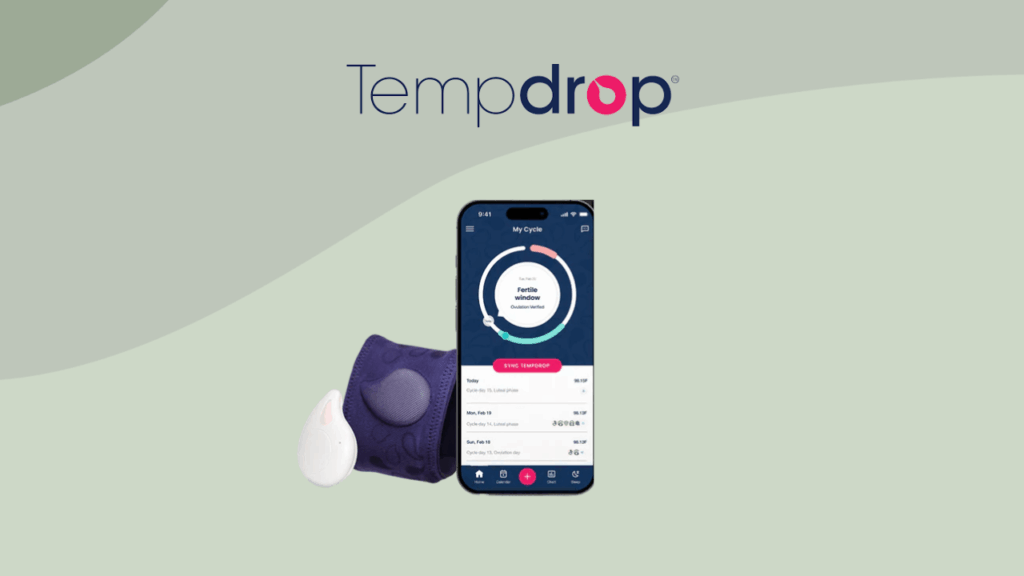
Tempdrop 2.0 uses a wearable underarm sensor system that automatically tracks your basal body temperature (BBT) continuously during sleep. As per its official site, the box contains a sensor, a fabric armband with an extender, coin cell battery, battery changing tool, and a user manual. Post-ovulation, rising progesterone levels stimulate thermogenic activity in the body, which typically causes a measurable increase in BBT.
Tempdrop 2.0 continuously monitors these subtle overnight temperature shifts using an internal BBT sensor and algorithm-driven data filtering system. The device gathers temperature patterns across sleep cycles, movement, and environmental changes to help identify more consistent fertility-related trends. Such an approach might help reduce disruptions caused by inconsistent wake times, poor sleep, travel, illness, or nighttime movement.
The device also includes a free syncing mobile app for iOS and Android, which acts as the central tracking and charting platform for the device. It syncs collected temperature data to the app, where the information is processed into fertility charts and cycle trend visualizations.
Tempdrop structures its fertility-tracking system around passive overnight temperature collection. The wearable continuously monitors temperature during sleep, allowing you to collect fertility-related cycle data without needing to wake at the same early hour every morning before movement or activity. The brand combines skin-temperature monitoring, environmental sensing, and a 3-axis accelerometer that tracks movement during sleep, while its patented Active Temperature-Noise Cancellation (ATNC) filtering system attempts to isolate stable resting temperature patterns. It can make long-term fertility tracking easier to maintain consistently. You can maintain ongoing BBT tracking even when your sleep schedule changes, your nights are interrupted, or your wake times vary significantly from day to day.
Tempdrop highlights adaptive overnight analysis by stating that its wearable continuously monitors your temperature and movement data. The app’s algorithm processes thousands of overnight data points to identify the periods when your body reaches its most stable resting baseline. The algorithm gradually adapts to your own physiological and sleep patterns over time. During your first 14 days of use, the device calibrates itself to your personal biometric trends and sleep behavior. After calibration, the algorithm continues refining nightly interpretation by filtering out disturbances and smoothing short-term fluctuations during sync processing, helping maintain more stable chart continuity despite inconsistent sleep conditions. The brand’s fertility-tracking system becomes progressively more personalized to your own sleep behavior and resting patterns without requiring rigid wake times or highly standardized morning routines.
Tempdrop’s device provides temperature data collection and fertility-awareness support. The company maintains classification as an FDA-registered thermometer, creating a structural boundary around what the device is permitted to claim clinically and legally. The wearable can collect overnight basal body temperature data, but it does not independently function as an automated ovulation-decision platform. You must still understand and apply broader fertility-awareness methods, chart interpretation, cervical-mucus tracking, or LH testing outside the device itself.
While the brand references research supporting overnight temperature monitoring, portions of the published validation landscape involve company-affiliated participation, leaving the proprietary implementation with a narrower collection of fully independent validation compared with more extensively studied fertility-awareness frameworks or FDA-cleared contraception platforms.
Clue and Tempdrop both operate within the femtech and reproductive health tracking segment, but they differ significantly in how they position their platforms, structure their technology, and approach cycle and fertility tracking. Clue positions itself as a menstrual and reproductive health tracking platform intended to support long-term cycle awareness through predictive analytics, educational resources, and clinician-reviewed insights. Meanwhile, Tempdrop operates with a specialized fertility tracking focus built around wearable biometric monitoring.
Their product and service ecosystems also highlight a distinction. Clue primarily delivers app-based services across multiple reproductive stages, including Clue Period Tracking, Clue Conceive, Clue Pregnancy, Clue Perimenopause, and the Clue Plus subscription platform. Its tracking ecosystem includes cycle predictions, PMS tracking, symptom logging, ovulation estimation, pregnancy tracking, and perimenopause support through manually logged health data combined with predictive algorithms. Meanwhile, Tempdrop offers a more concentrated hardware plus software ecosystem through the Tempdrop 2.0 Advanced Fertility Monitor, which features a sensor, dedicated app, and access to Tempdrop Academy. Instead of relying on manual symptom entries, the Tempdrop 2.0 sensor continuously records overnight temperature patterns through an upper arm wearable device that syncs with the app to identify fertility windows and ovulation trends.
Clue emphasizes clinician-reviewed educational resources, academic research collaborations, and strong health data privacy practices. The brand repeatedly highlights compliance with German and EU privacy laws and states that reproductive health data is not sold to third parties. Meanwhile, Tempdrop places emphasis on wearable device functionality, algorithm-based temperature analysis, and fertility awareness methodology. The brand also references FDA database registration for the sensor and highlights non-invasive overnight monitoring with no radiation exposure during sleep.
When comparing Natural Cycles and Tempdrop, the brands differ in terms of scientific positioning, scope of services, wearable integration strategy, and long-term reproductive health focus. Natural Cycles is focused on hormone-free birth control, fertility planning, postpartum tracking, and menopause support through algorithm-based cycle analysis. Meanwhile, Tempdrop is a wearable fertility tracking company focused primarily on overnight basal body temperature monitoring and fertility awareness charting.
Natural Cycles operates through a subscription-based app ecosystem that supports fertility tracking, ovulation prediction, birth control, pregnancy planning, postpartum monitoring, and perimenopause support. A few signature offerings from the platform include the NC° Birth Control, NC° Plan Pregnancy, NC° Postpartum, and NC° Menopause. The platform also integrates with devices such as the NC° Band, Apple Watch, Oura Ring, and basal thermometers. Meanwhile, Tempdrop maintains a more focused lineup built around the Tempdrop 2.0 wearable sensor and its companion app. The platform focuses on overnight skin temperature monitoring, fertility charting, sleep-related cycle tracking, and premium analytical features.
The technological framework and tracking methodology also differ between the brands. Natural Cycles relies on a regulated adaptive algorithm that evaluates temperature trends, cycle data, and fertility signals to estimate fertile and non-fertile days. Tempdrop focuses more specifically on wearable sensor technology that continuously captures overnight temperature and movement data from the upper arm during sleep, then processes the readings through filtering algorithms to generate basal body temperature estimates.
Natural Cycles provides reproductive health guides, cycle tracking insights, symptom logging, postpartum guidance, and healthcare professional resources integrated within its digital health ecosystem. Meanwhile, Tempdrop focuses more on fertility awareness education and wearable usability support through its blogs, Tempdrop Academy, charting guidance, cycle forecasting tools, and premium analytics features.
When evaluating Tempdrop, we analyzed the brand’s background, operational consistency, and standing across independent review forums. Operating since 2014, the brand has remained active in the fertility-tracking market for several years. However, the brand’s reputation across public review platforms appears mixed.
On Trustpilot, the brand carries a 2.9 out of 5 rating based on more than 145+ reviews. Positive feedback often mentions convenience, ease of cycle tracking, and usefulness for fertility awareness practices. However, negative reviews highlight concerns related to the reliability of insights from Tempdrop 2.0, inconsistent temperature readings, syncing problems, and discomfort from the armband. Some reviews also expressed frustration with customer service responsiveness, warranty handling, and refund delays.
Beyond Trustpilot, the brand has limited presence across other independent review platforms such as ThingTesting and Sitejabber. Based on the available data, Tempdrop appears to have established recognition within the fertility wearable category, but its public reputation remains affected by recurring concerns around support handling, product durability, and transparency.
To evaluate Tempdrop, we reviewed real user experiences shared across Reddit discussions focused on fertility tracking, cycle monitoring, and app experience.
Several users described that basal temperature readings were easier to maintain with Tempdrop 2.0, as it collects overnight temperature data passively through a wearable sensor. They also mentioned that the device reduced stress around manual tracking and helped them build longer-term cycle records with less effort. Some discussions additionally noted that the hardware continued functioning for years with only battery replacement.
However, feedback also highlighted repeated concerns about accuracy and timing precision. Some users reported that Tempdrop 2.0 detected ovulation shifts later than oral thermometers or LH testing, with delays ranging from one to several days in certain cases. Discussions also questioned the platform’s temperature smoothing algorithms, as some charts appeared more stable or cleaner than oral BBT data. Comparisons with alternatives such as the Apple Watch and Oura Ring were also common, particularly among users looking for broader health and fitness features beyond fertility monitoring. You may find it useful if you want easier, low-effort fertility tracking through passive overnight monitoring. However, recurring user concerns about delayed detection and algorithm-smoothed temperature charts suggest the device may have some accuracy concerns.
Tempdrop’s wearable-based system reduces much of the manual effort linked to traditional basal body temperature charting and supports more flexible tracking during inconsistent sleep schedules, shift work, or disrupted routines.
While the platform confirms ovulation after a sustained temperature rise, it does not predict ovulation in advance. The brand also recommends combining temperature tracking with cervical mucus observations or ovulation tests for better accuracy, especially during irregular cycles, postpartum recovery, stress-related hormonal fluctuations, or PCOS-related inconsistencies.
A careful consideration of factors like interrupted sleep, alcohol intake, inconsistent overnight wear, incorrect sensor placement, and changing sleep schedules remains important, as these might impact ovulation tracking reliability.
For highly predictive fertility planning or medically complex hormonal conditions, additional tracking methods, external interpretation, and professional medical guidance remain important.

Contact us at [email protected] or follow @leafsnap on Twitter! View our Privacy Policy.