

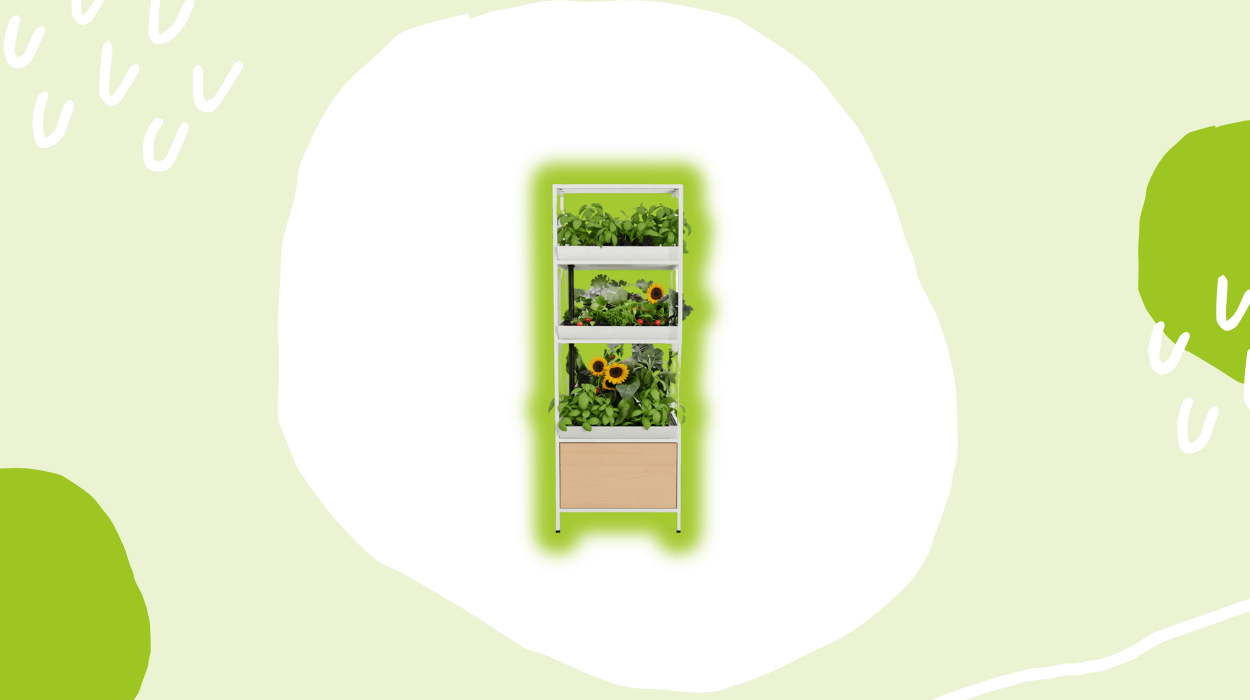

Rise Gardens is a home gardening brand that offers indoor hydroponic garden systems. It focuses on smart gardening products that combine modern design with technology for home use. The brand also emphasizes year-round indoor growing, reduced food waste, and access to fresh produce directly from home. Features highlighted by the company include guided app support, premium materials, and a wide variety of compatible seed pod options.
In this review, we examine some of the brand’s core offerings and compare it with similar brands. We also assess its advantages along with potential limitations to provide a more detailed analysis.
Rise Gardens offers gardening systems equipped with automated lighting, modular designs, and soil-free cultivation methods intended to simplify fresh food growing for both beginners and experienced home gardeners.
The product lineup ranges from compact countertop systems to larger expandable units such as the Personal Rise Garden, Rise Garden 3, and Rise Loft. In addition to garden systems, the brand also offers a broad catalog of hydroponic seed pods featuring varieties like Genovese basil, Red Oakleaf Lettuce, Kitchen Mini Siam Tomato, and Shishito Peppers.
The company also provides products such as Blossom Dry Nutrient, Sprout Dry Nutrient, pH Balance solutions, and pH Strips for use within its controlled growing systems. These offerings are intended to help maintain nutrient levels, monitor water conditions, and support healthier plant growth throughout different stages of cultivation.
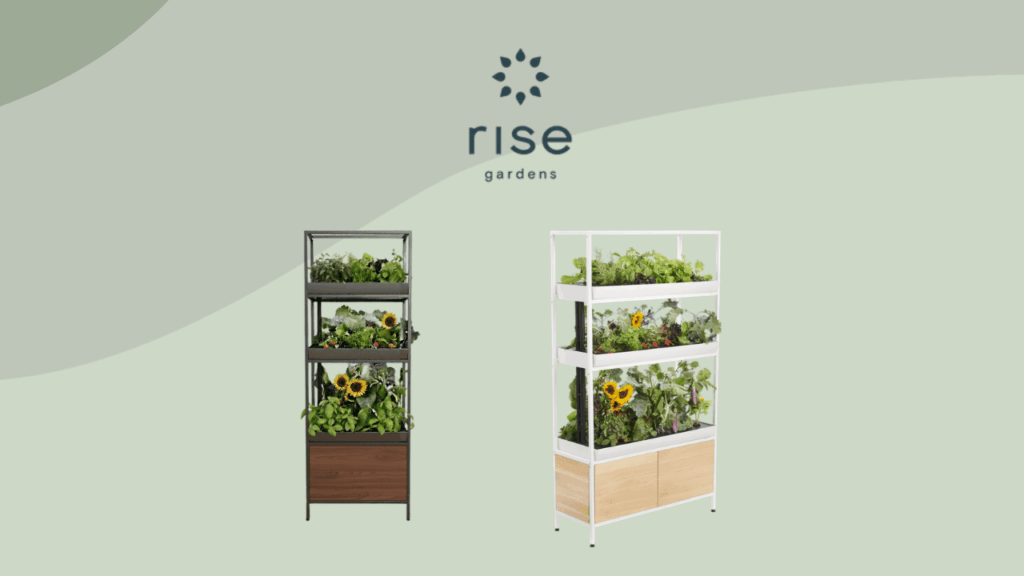
Personal Rise Garden is built for countertops and smaller living spaces, and comes with LED grow lighting, water-based cultivation, and app-guided growing tools.
According to the official website, the product supports up to 12 plants in a single compact level and uses 30W full-spectrum LED lighting to simulate the light conditions plants need for healthy growth indoors. Instead of soil, plants grow hydroponically in water with added nutrients, helping maintain a cleaner and more controlled growing environment. They might help support more sustainable farming by reducing water use and improving nutrient efficiency. The built-in water tank and guided nutrient system are designed to reduce maintenance while supporting consistent plant growth throughout the year. It is connected to the Rise Gardens mobile app, which acts as a digital growing assistant. The app provides smart notifications for watering, nutrient additions, pruning, and harvesting while also offering access to a plant library and growing guidance.
These systems can be used for growing fresh salad greens, herbs, strawberries, tomatoes, peppers, and other produce indoors, regardless of season. The compact format is designed for apartments, kitchens, breakfast nooks, and family spaces.
The Rise Garden 3 is available in one-level, two-level, and three-level configurations. According to the brand, its growing capacities range from 16 plants to 108 plants, depending on the selected setup and expansion level.
The system is designed around a horizontal growing structure that combines full-spectrum LED lighting, automated drip irrigation, and water reservoirs to support indoor plant growth without soil. Growing plants indoors is known to help with mood balance and stress relief. Each level includes 65W full-spectrum LED lights, and the modular design lets you expand the system over time by adding levels and growing trays. The largest three-level version measures approximately 66 inches in height and supports up to 195W of LED lighting power.
The system includes app-connected functionality through the Rise mobile app for iOS and Android. It also supports Wi-Fi, Bluetooth, and Amazon Alexa connectivity. Its contents may vary by configuration but generally include the base garden structure, nursery trays, seed starter bundle, nutrient starter kit, net cups, and modular extension components.
The Rise Garden 2 uses a self-watering hydroponic setup combined with modular expansion capabilities, allowing you to configure the garden in single-level, double-level, or triple-level formats. It is available in Charcoal and Cloud color options and features natural pine wood uprights combined with metal and plastic construction.
According to the brand, food-safe plastics are used in areas that come into contact with water and plants. Components such as trays, tubing, reservoirs, and lids are manufactured using polyethylene and polypropylene materials, while net cups are made from ABS plastic.
The Rise Garden 2 includes integrated grow lighting and automated watering support intended to simplify indoor cultivation. Its modular structure also supports different tray configurations, including 4-pod, 8-pod, and 12-pod tray lids.
Depending on the selected configuration, the system dimensions and energy consumption vary. The single-level model measures approximately 39.5 inches tall and consumes around 43 kWh per month, while the triple-level version reaches approximately 66.75 inches in height with an estimated monthly energy usage of about 100 kWh. It comes with a starter kit with seed varieties and hydroponic growing supplies. The included seed variety contains Parris Island Cos romaine lettuce, Italian parsley, curly parsley, chives, and celery. It also includes pod trays, net cups, hole covers, pH solution, and dry nutrient starter materials.
Rise Gardens pairs its hydroponic systems with a free app on iOS and Android that guides planting, transplant timing, watering, pH balance, and nutrient additions. The brand describes weekly task reminders, plant-cycle tracking, and remote care support, and it also supports Alexa connectivity on compatible systems. That guidance is built into the core customer journey from day 1 setup through day 30 first harvest.
The company runs a dedicated support center, contact channels, assembly manuals, a separate plant library, and an on-site AI assistant for garden selection and troubleshooting. Its education program adds another layer with partner-school coaching and curriculum resources, showing that the support model is built as an institutional capability.
You may find Rise more approachable if you want a structured operating system around indoor gardening and hardware. It gives you multiple support layers available when you need help with setup, crop planning, or recurring maintenance tasks.
Rise Gardens backs its gardens with a 90-day return window and a three-year limited warranty covering hardware, electronics, and authorized replacement parts. It also includes the Rise Plus membership program, which has seed credits, discounts, shipping benefits, and replenishment incentives. Financing through Affirm is also integrated into garden purchases. This means you can test the system inside a defined return window with stable product support when investing in a premium indoor hydroponic garden.
Rise Gardens requires a substantial initial financial commitment before ongoing consumable and membership costs are factored in. Entry pricing begins around $349 for the Personal Rise Garden, while larger furniture-style and modular systems such as the Rise Loft and Rise Garden 3 commonly start near $899 and can scale to roughly $1,449 for expanded multi-tier configurations. It extends beyond the hardware purchase itself. Maintaining the ecosystem long term often involves recurring costs tied to branded seed pods, nutrient solutions, replacement components, memberships, and optional growing accessories.
Consumable replenishment can add roughly $35–$40 per month when purchased separately, while Rise Plus memberships introduce additional annual costs that can range from approximately $199 to $299, depending on the system configuration. The higher upfront pricing and recurring maintenance costs can make long-term ownership noticeably more expensive.
Gardyn and Rise Gardens approach product design, growing capacity, automation, and long-term ownership differently. As per the official site, Gardyn’s lineup is comparatively streamlined, centered around the Gardyn Home and the Gardyn Studio. The Gardyn Home is priced at $899, supports 30 plants, and is positioned for households of 3-4 people, while the Gardyn Studio is priced at $549 with support for 16 plants for apartment living or smaller households. Rise Gardens offers a broader range of configurations with more scalability across different price points. Its Personal Rise Garden starts at $349 and supports 8-12 plants in a countertop format, while The Rise Garden 3 ranges from $899 for a one-level 16-plant system to $1499 for a three-level expandable system capable of growing up to 108 plants.
The growing architecture between the two brands is one of the clearest differences. Gardyn uses a vertical tower-style design intended to maximize plant density while minimizing floor footprint. The company repeatedly highlights compactness, apartment compatibility, and aesthetic integration into smaller living spaces. Rise Gardens instead promotes horizontal growing layouts with stacked modular shelves. Rise specifically states that its horizontal lighting arrangement provides superior light coverage compared to tower systems. Its Rise Garden 3 uses 65W full-spectrum LEDs per level, scaling to 195W on the three-level configuration, while Gardyn emphasizes automated light scheduling.
Automation is another major point of contrast. Gardyn places much heavier emphasis on AI-assisted growing through its Kelby smart gardening assistant. Cameras and sensors continuously monitor the garden, while Kelby generates personalized care plans and automated recommendations. Gardyn also automates light and water scheduling to reduce manual involvement. Rise Gardens uses automation more as a guided maintenance system. The Rise app provides notifications for nutrient additions, pruning schedules, harvest timing, and watering reminders, while also including a plant library and remote garden management tools.
Their ecosystem strategies also diverge. Gardyn offers a range of accessories and replacement parts such as HydroBoost, Sprout Nurseries, yPods, ySleeves, and accessory bundles. Rise Gardens instead builds a larger recurring ecosystem around its Rise Plus membership program. Rise Plus includes quarterly seed packs, free shipping, discounts on additional supplies, early seed access, and triple rewards points.
Both Gardyn and Rise Gardens position indoor gardening as a technology-supported alternative to traditional produce purchasing, but they build that experience differently. Gardyn prioritizes tightly integrated automation and a more curated ecosystem centered around efficiency, while Rise Gardens emphasizes configurability, production scale, and a broader home-growing infrastructure.
AeroGarden and Rise Gardens both operate in the indoor hydroponic gardening category, but the brands differ considerably in scale, hardware design, ecosystem structure, and intended usage. Its catalog is primarily built around compact countertop systems designed for smaller indoor spaces and shorter setup times, while Rise Gardens focuses on modular multi-level systems intended for larger harvest volumes and longer-term household food production.
The two brands also differ substantially in how they present production capacity and harvest expectations. AeroGarden emphasizes small-scale continuous indoor growing through seed pod kits such as Gourmet Herbs, Grow Anything, Mixed Romaine, and Cucumber Seed Pod Kits. Most AeroGarden seed kits range from $13.95 to $21.95 and are structured around single crop categories or themed gardening kits. Rise Gardens instead emphasizes larger-scale food output, stating that the Rise Garden 3 can grow between 12 and 36 plants per level. According to the brand, it can produce approximately 13 lbs per month in a one-level configuration, 26 lbs per month in a two-level configuration, and up to 40 lbs per month in the three-level system.
The hardware architecture reflects a major contrast in design philosophy. AeroGarden’s systems are primarily self-contained countertop appliances with integrated lighting and pod slots intended for compact indoor use. Rise Gardens uses a modular furniture-style structure with expandable vertical levels, full-spectrum white and red LED lighting, horizontal light placement for broader canopy coverage, and significantly larger water reservoirs. AeroGarden’s systems remain substantially smaller and are positioned more as kitchen appliances than permanent furniture-scale installations.
The seed variety strategy of the two brands differs both in scale and specialization. AeroGarden’s catalog includes herbs, leafy greens, tomatoes, cucumbers, peppers, eggplants, flowers, and customizable Grow Anything kits. Specific varieties include Sweet Banana Pepper, Fairy Tale Eggplant, Pesto Basil, and Mixed Romaine Lettuce. Rise Gardens promotes a broader catalog with more specialty-oriented crops, including Everbearing Strawberry, Sweet Broccoli Raab, European Tarragon, Red Oakleaf Lettuce, and edible flowers.
The maintenance ecosystem is also structured differently. AeroGarden’s setup revolves primarily around replacing seed pod kits, using grow lights, and adding accessories such as Seed Starting Systems, Stem Grow Lights, and Trio Grow Lights. Rise Gardens uses a broader recurring maintenance system with dedicated hydroponic nutrients, pH-balancing products, pH strips, replacement parts, and app-directed care reminders. Offerings include Sprout Dry Nutrient, Blossom Dry Nutrient, pH Balance solution, and pH test strips. Rise states that you replenish water and nutrients weekly while the app tracks maintenance schedules and harvest timing. The company also repeatedly describes the maintenance routine as requiring approximately five minutes per day.
We have evaluated the credibility of Rise Gardens by assessing information about the brand available on BBB, where the company has an F rating. The rating is primarily linked to a failure to respond to several complaints filed against the business. The complaint volume has remained relatively limited, but the users report unresolved and repeated cases.
The brand shows recurring issues related to delayed or missing deliveries, inventory shortages, and order fulfillment gaps. Several customers have reported receiving partial orders, extended shipping delays, or no tracking updates after purchase. There are also repeated concerns about subscription and membership fulfillment, where quarterly or scheduled shipments have been delayed or placed on hold due to stated inventory constraints. In multiple cases, customers have reported limited communication channels and difficulty reaching live support, with reliance on email or automated chat systems.
Our evaluation shows that improving responsiveness through direct support channels and reducing delays in addressing complaints could strengthen customer experience and trust. We suggest that you proceed cautiously with time-sensitive purchases and confirm product availability before placing orders. You may also benefit from preferring payment methods that offer strong buyer protection in case of delays or non-delivery.
We checked Trustpilot reviews and aggregated user feedback for RiseGardens to evaluate the real user feedback. The brand currently holds a TrustScore of 2.5 out of 5 from over 250 reviews.
Users report successful long-term use of the hydroponic systems, particularly the Rise Garden 2 and Rise Garden 3 units. Some reviews highlight strong early performance, including healthy growth of herbs, lettuce, tomatoes, and other vegetables, with one user noting especially good results with tomatoes and a generally rewarding indoor gardening experience.
However, consistent complaints around product performance issues also appear repeatedly, including seeds failing to germinate, uneven plant growth, and occasional defective components upon arrival. A few users report that plants stopped thriving after a few weeks despite careful monitoring of nutrients, pH levels, airflow, and lighting conditions, suggesting inconsistency in outcomes. Pricing is another point of concern, with some users stating that the system feels expensive relative to perceived reliability and results.
Subscription management also emerges as a recurring frustration, with complaints about out-of-stock products affecting scheduled deliveries, lack of refunds for missed shipments, and unclear handling of canceled subscriptions. Some customers specifically mention feeling ignored regarding order status updates, especially for pre-orders and backordered items.
We find that while these brand offerings can perform well in many cases, reliability issues in fulfillment, inventory transparency, and consistency of plant growth create significant dissatisfaction. If you are considering the brand, you should be prepared for variability in product performance that can interrupt ongoing use.
Rise Gardens’ premium, tech-integrated indoor gardening model relies heavily on tightly controlled inputs, which becomes more apparent under real-world growing conditions. Plant health in these managed environments depends on the consistency and balance of pre-formulated nutrition systems designed to simplify cultivation. While proprietary inputs reduce operational complexity, they also limit transparency into the exact nutrient composition and delivery profile, making deficiencies or growth irregularities harder to diagnose.
The consumable-driven structure also creates supply continuity constraints. Indoor gardening performance depends on consistent replenishment cycles and stable formulation quality. Delayed replacements, substitutions, or slight batch inconsistencies may trigger slower growth, uneven foliage development, or reduced plant vigor, especially in more sensitive crops.
The brand’s guided, automation-focused design further limits user-driven optimization as predefined operating parameters reduce granular control and restrict corrective intervention once the system is running.
Rise Gardens aligns with core controlled-environment cultivation principles through structured lighting, regulated nutrient delivery, and efficiency-focused design. However, its reliance on proprietary consumables and predefined operating boundaries creates a managed ecosystem where results remain dependent on supply consistency and adherence to system-specific inputs.

Contact us at [email protected] or follow @leafsnap on Twitter! View our Privacy Policy.