



Circle Medical operates in the primary care services space, providing access to medical consultations through both virtual appointments and in-person clinic visits. It offers same- or next-day appointment availability, access to board-certified providers, and prescription management services.
The platform’s services focus on improving healthcare accessibility, with emphasis on needs like primary care management, mental health support, weight management, and preventive health services.
In this review, we examine the brand’s service structure, care categories, and provider network. The review further explores its appointment process, digital care tools, and how the platform compares with other virtual healthcare providers.
Circle Medical is a digital healthcare platform that pairs virtual consultations with in-person primary care services through a network of U.S. licensed medical providers. It operates through an appointment-based model where medical consultations are conducted either through video visits or at physical clinic locations, with scheduling and follow-up care managed through a mobile application.
The platform structures its services across different clinical areas, including mental health, sleep concerns, hormone therapy, skin-related concerns, primary care, and ADHD care. Other service areas include contraception consultations, tobacco cessation support, and sleep disorder evaluations. Circle Medical app functions as the central interface for appointment scheduling, insurance verification, medical record summaries, prescription coordination, and communication between visits.
According to its official website, provider networks consist of board-certified clinicians across disciplines like family medicine, internal medicine, and behavioral health. Insurance coverage is described as available through many major U.S. private insurance providers, including Aetna, Cigna, United Healthcare, Anthem, and UMR. However, coverage depends on individual plan eligibility and provider network participation.
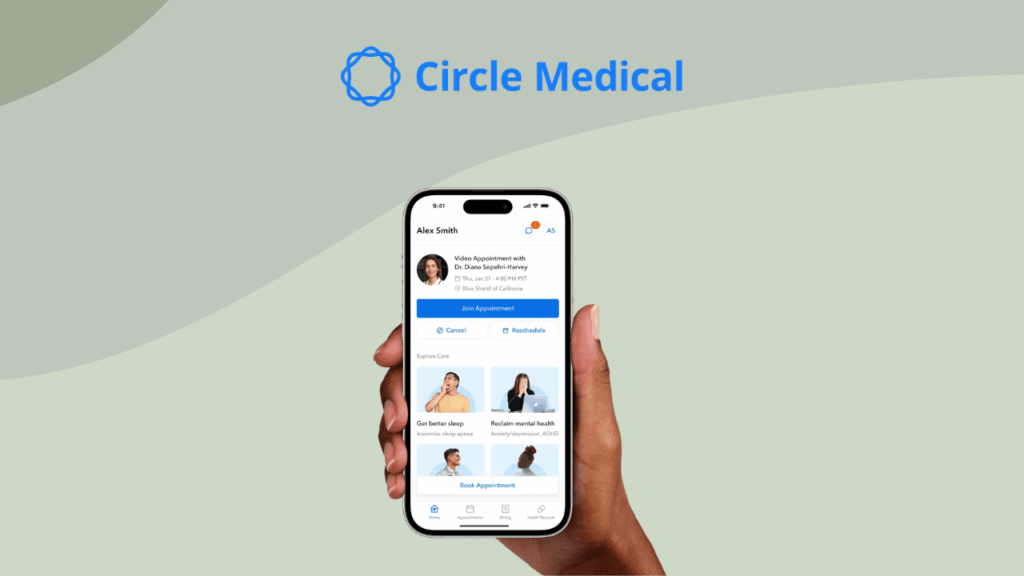
Hybrid Primary Care combines virtual telemedicine with in-person clinical services, allowing you to receive care through both video appointments and physical clinic visits when needed. According to the company, you can work with a single provider for ongoing care, with most interactions taking place through video visits and in-person appointments used when a physical exam, procedure, or further evaluation is required.
The brand states that you begin by selecting a provider and booking an appointment, often with same-day or next-day availability, and then meet with the provider through a video visit. If plans or prescriptions are clinically appropriate, they are provided during the visit, and you continue to manage your care plan through the platform, with follow-ups scheduled as needed.
The service includes preventive care, diagnosis, and support for common concerns. You can use it for annual wellness exams, screenings, and routine health monitoring. During an annual checkup, the provider reviews your medical history, current symptoms, medications, and lifestyle factors, and may order laboratory tests such as blood panels. Recommendations for screenings are based on your age, risk factors, and existing conditions, and the visit is used to establish or update a baseline view of your health.
The company also mentions that the service includes management of ongoing conditions such as hypertension. In this process, your provider monitors your condition over time through follow-up visits, reviews measurements such as blood pressure readings, and may prescribe medication or adjust the plan based on your response, side effects, and changes in your health status.
Urgent care is included as part of the same system and is available through same-day virtual visits for non-emergency concerns. The company states that these visits help in providing support for respiratory infections, urinary tract infections, skin conditions, allergies, and minor injuries. If your condition requires imaging, a physical exam, or urgent intervention, you are directed to in-person care or emergency services.
The service also extends into behavioral and mental health care, where Circle Medical states that it provides evaluation and support for conditions such as ADHD, anxiety, and depression, as well as sleep-related conditions like insomnia and sleep apnea. These services are integrated into the same care model, allowing you to address both physical and mental health concerns through the same platform.
Circle Medical presents a hybrid care model that pairs digital healthcare services with select in-person clinic access. The brand states that it follows a telehealth-first model, where most routine care can be managed through video visits, while physical clinic visits are positioned as a secondary option when direct evaluation is required. It lists in-person locations in cities like San Francisco and New York and states that these visits are appointment-based.
As per the brand, in-person services may include physical exams, laboratory testing, and required procedures. Providers are described as managing care across telehealth and in-person visits without requiring a change in platform. Integration of both visit types within one system may also make it easier for you to maintain continuity without switching providers.
Circle Medical’s care model is integrated with major commercial insurance networks. The brand states that it accepts plans from providers like Aetna, Cigna, UnitedHealthcare, and Meritain Health, with a focus on commercial PPO plans. The brand also notes that it generally does not accept Medicare, Medicaid, or Medi-Cal, which reflects a defined insurance participation scope.
The platform states that insurance verification occurs during the booking process. You are required to enter policy details and member identification before confirming appointments, and the system checks coverage, copays, deductibles, and estimated costs. The brand states that it sends claims directly to insurers and provides final billing statements within about 4 to 6 weeks based on coverage outcomes. Any remaining balance can be paid through the platform.
Insurance integration could make it easier for you to use existing commercial coverage without managing separate claims processes. Built-in eligibility checks and billing management may also help you better understand expected costs and manage payments within one system.
Circle Medical presents its virtual care model as covering multiple U.S. states, including Washington, D.C. The brand states that its providers often hold licenses in more than one state, allowing them to deliver care while following state-specific regulatory requirements. The platform also indicates that it continues expanding both its virtual coverage and select in-person services. The brand lists in-person availability in locations such as California and New York and states that it may coordinate referrals to local laboratories, pharmacies, or specialists when services cannot be completed through telehealth alone. Such a structure could make it easier for you to access personalized care across different locations without leaving the platform.
Circle Medical claims its clinician network is composed of licensed and board-certified healthcare professionals. As per its official website, the brand states that its network includes more than 400 physicians, nurse practitioners, and physician associates who provide services across preventive care, chronic condition management, and urgent care.
The platform also highlights examples of individual providers to illustrate experience levels within its network. Some names feature Dr. Lynne Lazarus in Family Medicine, Benjamin Brackett (PA-C), and Steven Winslow (PA-C). Such examples reflect a mix of physicians and advanced care practitioners with varied clinical backgrounds. The brand also claims it supports continuity of care through its app. You may see the same provider across visits, depending on availability. This helps maintain consistent care plans and familiarity with your history.
Circle Medical’s operational structure indicates variation in how administrative processes are carried out across different cases. While the platform uses digital systems for prescriptions, scheduling, and documentation, execution does not always follow a uniform pattern. Prescription workflows may involve delays in transmission to pharmacies, medication adjustments, or additional requirements such as lab testing or follow-up visits before approval, which may extend timelines even for routine requests.
Scheduling and communication processes can have inconsistencies, such as provider cancellations, rescheduled visits, or reassignment to a different clinician. In some cases, follow-up instructions and billing details may not remain fully consistent across interactions. Administrative documentation and billing workflows may also require extended processing time. Tasks such as insurance documentation, medical paperwork, or billing corrections may take several weeks and may require multiple follow-ups rather than being resolved in a single step.
These administrative variations may require more active follow-up from you when managing prescriptions, appointments, or documentation. Additional coordination may also be needed to confirm details or track progress, which could make the process feel less predictable.
Circle Medical maintains a strong dependence on its mobile application as the primary channel for nearly all interactions. The platform requires the use of the app to schedule appointments, message providers, attend video visits, access medical records, manage prescriptions, and handle billing or support requests. While this centralized structure supports privacy within a HIPAA-compliant system, it also limits the use of alternative communication channels such as direct phone-based support.
The platform also relies on structured messaging workflows to manage requests. Submitted inquiries typically move through preset intake questions before being routed to the appropriate team, such as billing or prescription support. While this may help organize requests, it can limit real-time interaction. Scheduling errors, delayed messages, or technical connection issues may affect how smoothly appointments, follow-ups, or administrative tasks progress.
An app-dependent structure may require you to rely heavily on the platform for all care-related communication and management. Response timing may feel slower if your preference includes direct or real-time interaction methods.
Carbon Health and Circle Medical both operate within the hybrid primary care and digital healthcare space. However, even with the similarities, the platforms have some differences in their service breadth, operational partnerships, specialization scope, and care coordination ecosystem.
In terms of positioning, Carbon Health functions as a broad multi-service healthcare network built around both primary and urgent care infrastructure. Its model integrates services such as urgent care visits for infections and minor injuries, preventive primary care, mental health consultations, women’s health services, pediatric urgent care, and occupational health programs. Meanwhile, Circle Medical structures most services within a primary-care-first framework, where behavioral health, sleep care, hormone care, ADHD consultations, and gender-affirming care are positioned as extensions of primary care relationships.
Technology integration shows similarities in app-centered workflows, but differences in emphasis. Carbon Health highlights digital medical record consolidation, prescription management, lab result access, and post-visit follow-ups. Meanwhile, Circle Medical emphasizes software coordination features like provider matching, digital intake workflows, insurance verification tools, and structured care pathways designed around ongoing provider relationships.
Provider network structure also reflects a difference. Circle Medical highlights a distributed network of more than 400 board-certified providers and references credentialing frameworks tied to evidence-based practice standards. Meanwhile, Carbon Health emphasizes its physician-led organizational structure and integrated clinic network supported by internal clinical leadership and technology teams rather than highlighting provider counts.
Operational partnerships further distinguish the models. Circle Medical references collaboration with UCSF as part of its clinical and platform development structure, indicating links to an academic medical ecosystem. On the other hand, Carbon Health emphasizes its clinic expansion strategy across multiple states and its hybrid retail-clinic model supported by digital infrastructure rather than academic partnerships.
When comparing PlushCare and Circle Medical, both platforms operate within the technology-enabled healthcare access segment. They emphasize app-integrated platforms, video consultations, and digitally coordinated care delivery. However, differences appear in care structure, pricing models, provider interaction style, and accessibility.
PlushCare functions primarily as a virtual-first care provider built around fully remote consultations, with services delivered mainly through scheduled video visits. Its service scope includes primary care consultations, urgent care evaluations, pediatric visits, mental health therapy, sexual health consultations, and physician-supervised weight management programs. Meanwhile, Circle Medical instead operates as a hybrid model by combining digital healthcare with physical clinic access, placing greater emphasis on continuity between virtual visits and in-person examinations when required. Its services cover multiple areas, including mental health, hormone therapy, sleep concerns, skin-related concerns, primary care, and ADHD care.
Pricing structure represents another point of difference. PlushCare integrates a membership framework typically priced around $19.99 per month, combined with per-visit consultation fees, such as approximately $129 for self-pay visits. Meanwhile, Circle Medical follows a visit-based billing structure without membership fees, relying on insurance billing or direct payment similar to conventional outpatient clinics.
Technology implementation reflects similar digital coordination goals but a different operational focus. PlushCare emphasizes HIPAA-compliant telehealth infrastructure, prescription coordination, lab ordering, and nationwide availability through its virtual model. Meanwhile, Circle Medical also highlights HIPAA-compliant standards, alongside features like insurance verification tools, centralized medical records, and provider matching.
PlushCare operates as a virtual healthcare platform centered on remote consultations, membership access features, and nationwide telehealth availability for routine medical needs. Meanwhile, Circle Medical operates as a hybrid primary care platform emphasizing continuity of care, provider relationships, and integration between digital consultations and physical clinic visits.
We evaluated Circle Medical’s brand reputation using publicly available information from the Better Business Bureau, where the company currently holds an A+ rating. Its customer reviews highlight some level of dissatisfaction, which also appears to influence the brand’s perception. Common concerns include billing and insurance-related challenges, such as unexpected charges, higher-than-estimated costs, incorrect billing codes, and disputes tied to insurance processing.
There were also frequent concerns related to customer support access. Many reported difficulty reaching assistance, reliance on in-app messaging systems, delayed responses, and limited opportunities for direct human interaction. These factors contribute to frustration, particularly when users are attempting to resolve time-sensitive issues.
These findings indicate that while Circle Medical demonstrates strong credibility through its rating, ongoing concerns related to billing practices, customer support accessibility, and care consistency may impact its broader brand reputation.
We evaluated the real user experiences for Circle Medical by reviewing publicly available customer feedback from Trustpilot, where the company holds a rating of 3.8 out of 5 based on over 1,195+ reviews.
Across the reviews, many users describe positive experiences with healthcare providers. Customers frequently highlight that doctors and nurse practitioners are attentive, professional, and willing to listen. Some also mention that providers take time to explain plans clearly and offer thoughtful guidance.
Users also report that scheduling appointments is quick and straightforward through the app, with same-day or next-day availability often mentioned. The ability to attend appointments remotely is seen as practical by those who prefer avoiding in-person visits. Some also report that communication through chat features is efficient and allows for easy follow-ups.
On the other hand, recurring concerns appear around pricing and billing. Several users report unexpected charges, unclear cost structures, or multiple appointment requirements that increase expenses. Customer service and administrative processes also receive mixed feedback. While some users report smooth experiences, others describe difficulty reaching support, inconsistent information from different representatives, or challenges resolving account and scheduling issues. There are also problems related to prescription management, including needing multiple appointments for refills or being unable to obtain specific medications.
Based on our evaluation, we find that while the platform can provide accessible and supportive care, improvements in pricing clarity, communication, and service consistency may enhance user satisfaction and experience with the brand.
Circle Medical reflects a broader shift toward a hybrid care model by pairing virtual consultations with physical care access. It focuses on improving access to routine care rather than functioning as a fully integrated diagnostic system. The platform’s services work best for routine concerns and preventive care, while more complex concerns may require multiple visits due to shorter appointment times. It is also important to note that laboratory testing is typically handled through external providers, which may require separate visits, coordination steps, and third-party billing.
The suitability of Circle Medical’s services depends on factors like geographic availability, insurance compatibility, preference for virtual consultations, and the scope of care required. It is important to maintain realistic expectations about consultation limits, external testing steps, and cumulative service costs.

Contact us at [email protected] or follow @leafsnap on Twitter! View our Privacy Policy.