
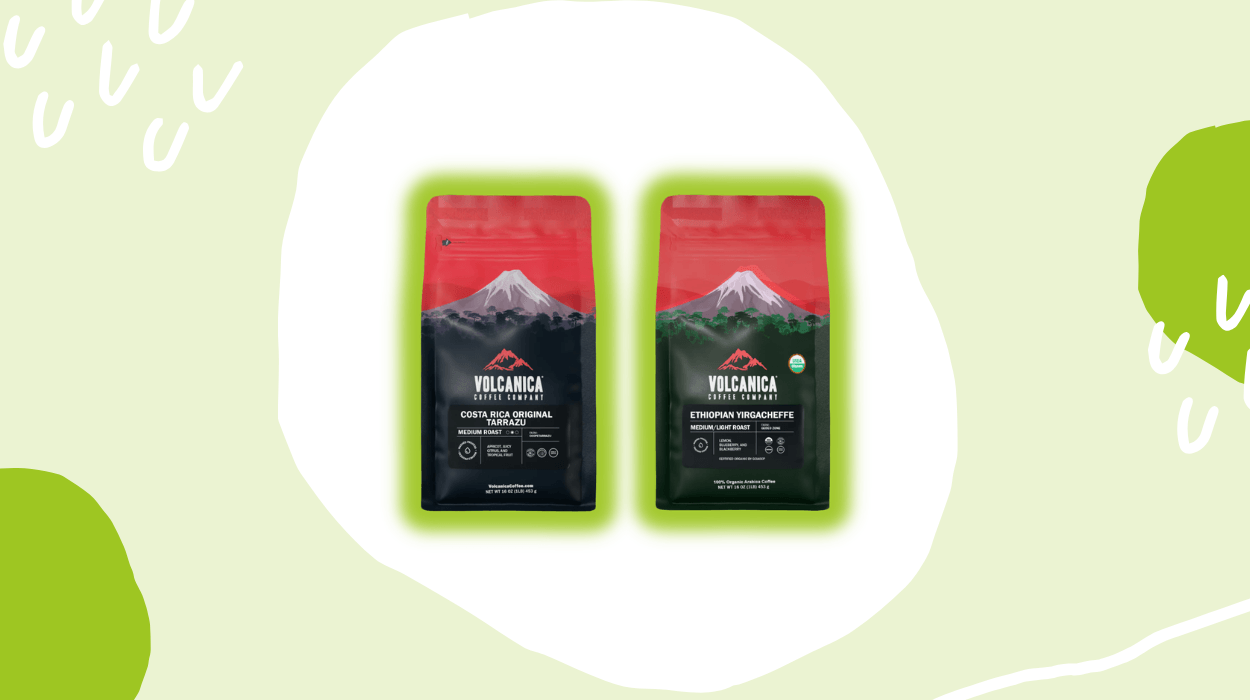

Volcanica Coffee offers specialty coffees sourced from volcanic regions known for high-altitude growing conditions and mineral-rich soil profiles. The brand keeps its identity around single-origin Arabica coffees, region-specific roasting, and flavor-driven sourcing.
Its catalog highlights globally sourced coffees from regions such as Ethiopia, Costa Rica, Sumatra, Colombia, Jamaica, and Hawaii. These offerings are intended to help boost energy levels, lower fatigue, and improve focus and alertness.
The review will examine the brand’s sourcing approach, roast consistency, coffee quality standards, and range of offerings. It also explores the advantages and potential limitations associated with the brand.
Volcanica Coffee is a family-owned coffee brand that traces its inspiration to Costa Rica. The brand keeps its catalog around exotic and single-origin coffee. Its catalog is organized by roast profile, region, and coffee specialty, which helps you filter selections across light, medium, and dark roast categories. It also separates products through specialty classifications, including varieties like low-acid, peaberry, organic, fair-trade, shade-grown, decaf, estate, and fermented coffee.
According to its official website, the brand states that it fresh roasts coffee weekly at its Atlanta-area roasting facility, where coffee is roasted at temperatures above 400°F, and products are not shipped with roast dates older than two weeks. The brand also mentions that all its offerings undergo phytosanitary testing and additional laboratory testing for mycotoxins such as ochratoxin A.
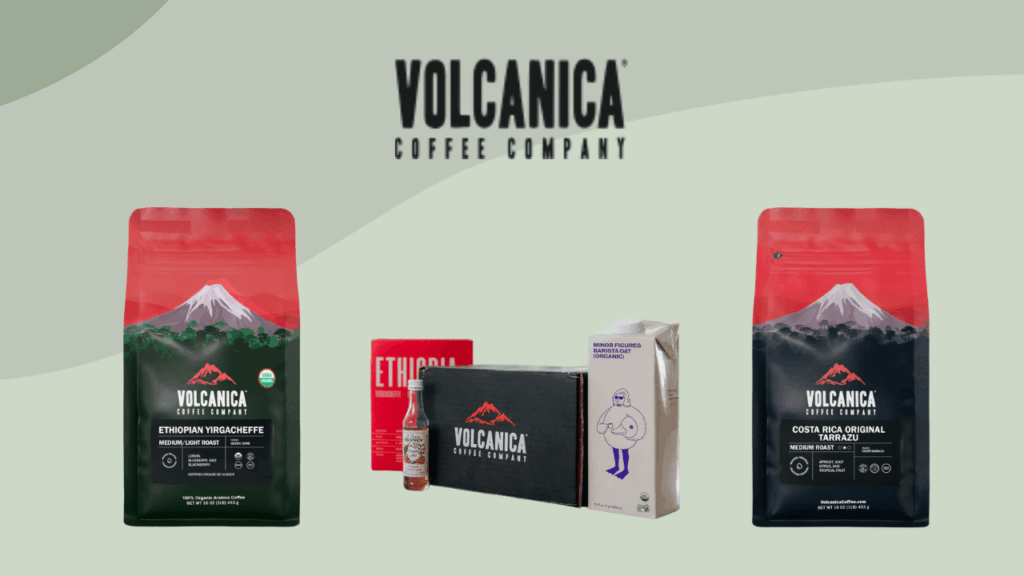
Ethiopian Yirgacheffe Coffee is a single-origin specialty coffee sourced from the Gedeo Zone in southern Ethiopia. It is a medium-light roast designed to preserve the coffee’s naturally complex flavor profile and high acidity.
The beans are cultivated at very high altitudes, where cooler temperatures slow the ripening process of the coffee cherries. This slower development contributes to denser beans with high caffeine and more concentrated flavor compounds. The brand states that the coffee is made from heirloom Arabica varieties.
Sumatran Dark Roast Coffee is described as offering an earthy, chocolate-focused option. It is presented as being roasted darker than other coffees, with the intention of creating an intense and sweeter flavor profile. Flavor profile includes notes of brown sugar, dried fruit, and a wine-like finish, which are said to combine into a layered but grounded taste experience.
The coffee is made using the Sumatran wet-hulling process, which is described as a method where coffee is partially dried before final milling. This process is commonly associated with Indonesian coffees and is said to contribute to an earthy, full-bodied profile. It is also described as tending to reduce perceived acidity while increasing depth, resulting in a heavier mouthfeel and a more rustic flavor structure.
Tanzania Coffee is sourced from the Kilimanjaro region of Tanzania, an area commonly associated with African coffees that exhibit fruity characteristics along with acidity and sweetness. It is made exclusively from peaberry beans.
The coffee is offered in Tanzania Peaberry Coffee and Tanzania AA Coffee options, which are presented as providing different flavor profiles depending on preference. According to the brand, the AA designation refers to the highest grade of beans from the crop. This version highlights brightness, citrus-like acidity, and a floral-fruit character. The Peaberry variant is a slightly darker option that softens the perceived acidity while bringing forward deeper sweetness and more rounded cocoa-like notes.
Costa Rica Coffee is presented as having a structured flavor profile that is smooth and refined. The brand offers multiple variants, including Costa Rica Peaberry Coffee, Costa Rica Tarrazú Original, and estate offerings such as washed and honey.
The core flavor profile is generally positioned within a bright and gently sweet range, with tasting notes that include lemon, almond, honey, citrus, and light chocolate undertones. Citrus notes contribute to a cleaner acidity, while almond-like nuttiness provides a softer base. Honey sweetness is associated with a smoother cup and a more balanced drinking experience.
Colombian Supremo Coffee is positioned as a medium roast intended to highlight smoothness and clarity, making it suitable for everyday consumption.
The brand associates this coffee with a layered flavor profile that includes chocolate, orange, and caramel notes. It is typically roasted to a medium level, which is intended to preserve origin characteristics while reducing some of the sharper edges sometimes associated with lighter roasts. Colombian Supremo Coffee is also presented as suitable for multiple brewing methods, including drip coffee, pour-over, and French press.
Kenya AA Coffee has notes of raspberry, cranberry, and floral undertones. Raspberry is associated with a juicy, slightly sweet character that forms the initial fruit-forward impression. Cranberry contributes a sharper tartness that adds brightness, while floral notes provide a lighter aromatic layer.
The coffee is noted for its high acidity in the form of chlorogenic acids, which are known to help with oxidative stress. The acidity is linked to its medium-light roast profile, which is intended to preserve origin characteristics and highlight natural fruit-like qualities. The brand also references a combination of sun-drying and washed processing methods, which are associated with maintaining consistency and supporting a clean, focused flavor profile.
Low Acid Coffee is a blended coffee with reduced acidity. It is formulated using naturally lower-acid Arabica beans sourced primarily from regions such as Brazil, Sumatra, and other origins associated with a heavier body and softer brightness. The coffee is positioned as an everyday option for caffeine. Its flavor profile is centered on chocolate, nuts, and tangerine. Chocolate provides smoothness to the texture while nutty undertones add a warm, mellow depth, and tangerine provides a subtle citrus element. According to the brand, the coffee is processed using washed methods and roasted to a medium level, which is intended to support consistency and reduce harsh or intense characteristics.
Volcanica Coffee centers on coffees from volcanic growing regions and states that it sources beans from volcanic areas around the world, with a strong emphasis on single-origin offerings.
The range includes Ethiopia Yirgacheffe, Costa Rica Tarrazu, Sumatra Mandheling, Guatemala Antigua, Brazil Minas Gerais, Tanzania, Jamaica, and Komodo Dragon Coffee from Flores. The brand also identifies farm details on many listings, including Gedeo Zone, Mandiri Kopi, La Hermosa Estate, and Tarrazu Estate.
The model is also supported by a broad portfolio structure built around region, roast, and specialty collections, across single-origin, estate, peaberry, decaf, and flavored lines. You can explore the brand by origin with a clearer sense of whether you are buying an estate coffee, a regional single origin, a peaberry lot, or a specialty category like low-acid or decaf.
Volcanica Coffee states that it roasts coffee every week in its Atlanta facility and usually ships within one business day. The freshness claim is also supported by offering whole-bean and grind-format coffee directly through its website, subscriptions, sample packs, and regional collections. It shortens the gap between roasting and delivery.
The brand also claims that it uses specialized, SCA-trained in-house roast masters who manually control batch profiles to handle delicate single-origin variables. You may value this if stale inventory is a concern or if you order coffee online and want a clearer roast-to-delivery path. It can help with rotating through different origins without relying on unknown shelf time at a third-party retailer.
Volcanica Coffee’s large-scale operational model creates several fulfillment and customer experience concerns tied directly to processing complexity and warehouse standardization.
Customized grind fulfillment remains highly processing-intensive because supporting Espresso, Drip, Pour Over, French Press, Turkish, and other grind profiles across rotating single-origin coffees requires constant grinder purging, recalibration, and strict bean separation to prevent flavor crossover between distinct beans and flavored varieties. This adds operational slowdowns, particularly for pre-ground orders.
The catalog structure also creates unusually high price-entry barriers for luxury coffees. While standard coffees like Costa Rica Tarrazu are available for around $19.99 per 16-ounce bag, premium varieties such as Kona Peaberry are available for $129.99, and Jamaican Blue Mountain for $119.99–$159.99. They are often marketed in the same full 16-ounce format instead of smaller 4-ounce or 8-ounce sampler sizes. This forces you into expensive upfront purchases simply to test rare-origin coffees, limiting casual exploration while also increasing freshness risk once delicate micro-lot beans are opened.
Lifeboost Coffee is built around a clean coffee formulation approach. A central element of its production approach is the TrustPure process, a 15-step system that includes shade-growing coffee at high elevations, hand-picking ripe cherries, sun drying, and spring-water washing. The brand highlights extensive testing of its beans for more substances like mycotoxins, molds, heavy metals, pesticides, glyphosate, and acrylamide. Volcanica Coffee Company is structured more as a specialty coffee retailer focused on origin diversity and regional flavor profiles. Its product range is built around single-origin coffees sourced from multiple regions, including Ethiopia, Costa Rica, Sumatra, Kenya, Guatemala, Peru, Mexico, and Indonesia. The company highlights growing conditions such as volcanic soil, high altitude farming, and slower cherry ripening, linking these factors to flavor developments. Its catalog includes coffees like Ethiopian Yirgacheffe, Kenya AA, Costa Rica Tarrazu, and Sumatra Mandheling.
The sourcing approach differs significantly between the two brands. Lifeboost Coffee relies on a controlled single-origin model where consistency and internal standards are prioritized, particularly through its TrustPure process that applies across its entire product range. This includes its core roasts such as light Optimist, medium Grata, and dark Embolden, as well as decaf and flavored varieties. Volcanica Coffee Company instead sources from a wide network of farms and estates globally, offering a larger and more varied catalog that includes regional coffees, peaberry selections, reserve lots, espresso blends, flavored coffees, and decaf options.
Lifeboost Coffee is organized around a controlled production system with emphasis on testing, consistency, and digestive tolerance, supported by a structured internal process applied across a relatively limited product range. Volcanica Coffee Company operates as a broader specialty coffee platform focused on geographic sourcing, variability in flavor profiles, and origin-specific characteristics.
Coffee Bros and Volcanica Coffee both operate in the specialty coffee category, but they differ in sourcing structure, catalog organization, flavor presentation, pricing spread, and the ecosystem built around their products. As per the official site, Coffee Bros maintains a more focused specialty coffee and espresso-oriented lineup, while Volcanica Coffee’s official site shows a larger origin-driven catalog centered around coffees sourced from volcanic regions worldwide.
Volcanica Coffee operates with a significantly broader catalog structure that includes single-origin coffees, reserve coffees, peaberry coffees, flavored coffees, natural process coffees, espresso blends, low-acid coffees, and multiple decaf variants. The assortment includes Ethiopian Yirgacheffe, Kenya AA Coffee, Tanzania Peaberry Coffee, and Costa Rica Peaberry Coffee. The catalog also contains products such as Jamaican Blue Mountain Coffee from the Clydesdale estate, alongside reserve offerings including Sulawesi Dark Roast Coffee Reserve and Papua New Guinea Dark Roast Coffee Reserve. Compared with Coffee Bros’ narrower lineup, Volcanica Coffee functions more as a large-scale specialty coffee marketplace with extensive regional segmentation.
Low-acid coffee segmentation is another major distinction. Coffee Bros does not prominently organize products around acidity-related functionality, instead focusing more on roast style, sweetness, espresso compatibility, and flavor structure. Volcanica Coffee strongly emphasizes low-acid positioning throughout its catalog. Products such as Low Acid Coffee, Sumatra Mandheling Coffee, Komodo Dragon Coffee, Guatemala Antigua Coffee, Low Acid Decaf Coffee, and Espresso Dark Roast Decaf Coffee are explicitly positioned as lower-acidity options. The Low Acid Coffee blend combines beans from Brazil, Sumatra, and other lower-altitude Arabica coffees and is described as suitable for acid-related sensitivity. This type of functional segmentation is largely absent from the Coffee Bros catalog.
Coffee Bros also includes coffee equipment, espresso hardware, grinders, and brewing tools as part of its product range. The company offers options such as the Lelit Bianca V3 dual boiler espresso machine, Rocket Espresso R58 Cinquantotto, Breville Barista Express Espresso Machine, and Baratza Sette 270Wi grinders. The catalog also includes beginner espresso bundles, puck preparation tools, manual brewing equipment, filter coffee grinders, and cold brew accessories. Volcanica Coffee does not offer any other products apart from coffee, focusing more heavily on educational content related to coffee origins and growing regions.
Coffee Bros operates around espresso preparation, roast precision, structured flavor categorization, and brewing equipment integration. Volcanica Coffee highlights an extensive regional diversity, large-scale catalog depth, and a stronger emphasis on volcanic-region sourcing.
When evaluating Volcanica Coffee, we reviewed real user experiences shared on Amazon for two of the brand’s popular specialty coffee blends to understand how they perform in regular day-to-day use.
Sumatra Mandheling Dark Roast Coffee carries a 4.5 out of 5 rating based on more than 200 reviews. Many users described the coffee as rich, smooth, full-bodied, and low in acidity, with several users appreciating earthy notes and chocolate-like depth. However, a few users felt the product was overly bitter, while others raised concerns about freshness consistency, especially among subscription users who reported receiving bags outside what they considered an ideal roast window.
The Colombia Supremo Coffee holds a 4.2 out of 5 rating, which is based on 100+ reviews. Positive feedback highlighted its balanced flavor, smooth mouthfeel, strong aroma, and fresh packaging design. However, some users reported bitterness issues, and one user mentioned receiving ground coffee instead of whole beans despite the product description stating otherwise.
Based on the available feedback, our evaluation shows that most users noted positive experiences around flavor quality, dark roast depth, and specialty coffee variety. However, a portion of feedback also points to occasional concerns related to freshness consistency, pricing, and order accuracy.
To evaluate Volcanica Coffee, we analyzed the brand’s operational background, product focus, customer service responsiveness, and presence across independent review platforms. Its long-running market presence and continued activity in the specialty coffee space suggest an established business structure.
On Trustpilot, the brand carries a 4.8 out of 5 rating based on more than 8,300 reviews. Many reviews described consistent freshness, recent roast dates, a broad coffee variety, and responsive customer support. Several reviews also mentioned positive interactions with company representatives when discussing subscriptions, grind preferences, or replacement shipments. However, one review noted the brand’s Guatemala Antigua Medium Roast coffee as having a weak flavor profile. A few reviews also expressed concerns around burnt or bitter taste, inconsistent roast quality, and dissatisfaction with some single-origin coffee blends.
The brand shows minimal to no active presence across other independent review platforms such as Thingtesting, Better Business Bureau, and Sitejabber. Our evaluation indicates that the brand maintains a stable reputation in the specialty coffee market. However, product consistency, roast preferences, and customer service responsiveness highlight areas of improvement for the brand.
Volcanica Coffee emphasizes a quality sourcing approach, specialty coffee range, and fresh-roasted offerings. Roast selections, grind customization, and sourcing transparency may create a more tailored experience if you enjoy exploring flavor differences beyond standard grocery store blends.
However, the brand’s extensive catalog features similar regional varieties, reserve coffees, and multiple roast options, which can make selection more confusing if you are unfamiliar with flavor profiles or brewing methods. The brand’s lineup further lacks convenience-based formats, such as instant coffee or ready-to-drink options, which may feel less practical for busy schedules, travel, or grab-and-go use.
Some specialty coffee blends may also affect you differently due to stronger caffeine intensity or higher acidity levels. Excessive intake might contribute to restlessness, sleep disruption, digestive discomfort, or an increased heart rate. When considering the brand’s offerings, narrow your preferences around roast level, brewing method, flavor profile, and caffeine tolerance. Reading origin notes carefully also matters because volcanic-region coffees can vary widely in acidity, body, fruitiness, and strength.

Contact us at [email protected] or follow @leafsnap on Twitter! View our Privacy Policy.