

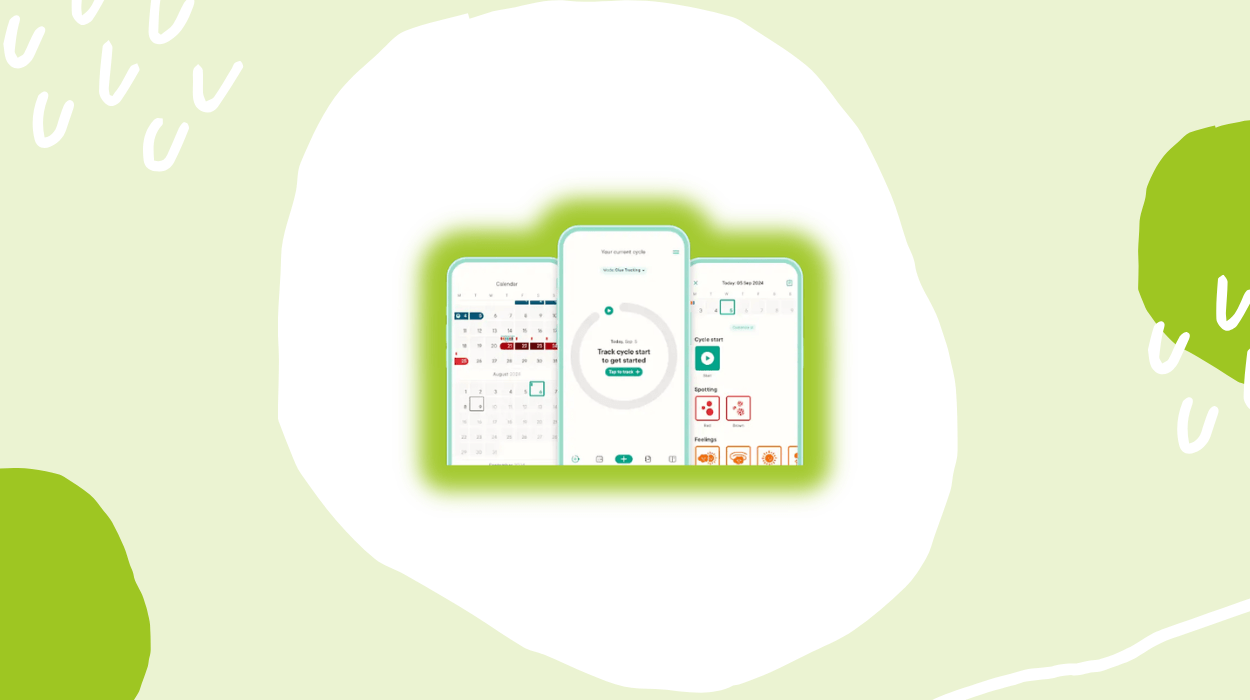

Clue is a women’s health and period tracking platform built around a mobile app that helps you monitor your menstrual cycles, ovulation, and reproductive health.
The brand focuses on supporting concerns related to cycle awareness, fertility planning, reproductive health education, and general body awareness. It also provides personalized insights based on tracked data to help you identify patterns in health over time.
In this review, we look at the platform’s main offering and assess its advantages and potential limitations. We also compare it with similar brands to provide you with a detailed analysis.
Clue is focused on helping you understand your body through evidence-based medical information. It was co-founded in 2012 in Berlin by Ida Tin, along with Hans Raffauf, Moritz von Buttlar, and Mike LaVigne.
The platform operates through interconnected apps under the ecosystem, with core offerings that include the period tracking app Period & Cycle Tracker, Baby Tracker, and Conceive. The brand also offers a Clue Plus premium subscription that unlocks advanced analytics, AI-supported insights, and expanded educational content.
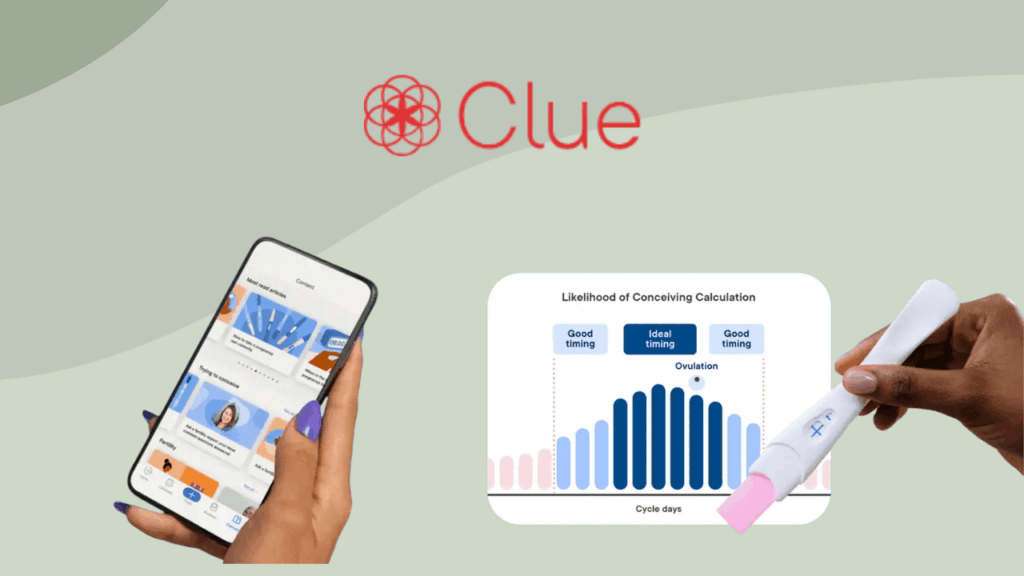
The Clue app helps you understand your body through daily logging, cycle predictions, and data-driven insights across different life stages. It helps you track your menstrual cycle by recording bleeding, symptoms, mood changes, energy levels, and other physical experiences. Based on this information, it may help you identify patterns in your cycle and estimate key phases such as your period, PMS window, and ovulation.
The app organizes this information into visual charts and timelines so you can see how your cycle behaves over time and how your experiences may shift from one phase to another. It includes multiple specialized modes, such as Conceive, Pregnancy, and Perimenopause, that expand its use depending on your needs. There is also a tracking mode for situations where you do not experience a period but still want to monitor hormonal or symptom-based cycles. Clue can also connect with wearable devices, allowing you to combine biometric data like temperature, sleep, and heart rate with your cycle tracking.
Clue operates under European Union privacy law and Germany’s strict GDPR enforcement standards through its parent company, Biowink GmbH.
The company says it has never shared private reproductive-health data with authorities and publicly commits to challenging outside data requests. It also states that research data is processed using de-identification, encryption, pseudonymization, and data-masking systems before being shared with approved research partners.
You can separately control research participation, personalization, and optional data sharing through detailed privacy settings. This structure may feel more reassuring if strong reproductive-health privacy protections and granular consent controls matter heavily in your decisions.
Clue separates its platform into a basic free version and the paid subscription system. Free accounts retain access to standard cycle logging, limited symptom tracking, and basic short-term forecasting, while many of the platform’s more advanced analytical and reproductive-health features remain locked behind the premium tier.
Premium access is required for extended cycle forecasting of up to 12 cycles ahead, unlimited custom tracking tags, Oura Ring integration, Clue Connect partner sharing, and deeper historical trend analysis.
Subscription also applies to specialized reproductive modes such as Conceive and Perimenopause. While Clue Pregnancy includes a limited free layer for viewing current pregnancy week and due-date tracking, more detailed tracking categories, expanded insights, and weekly fetal-development content require a paid subscription. This creates a noticeable divide between baseline logging functions and the platform’s broader personalization ecosystem. You may find this limiting if you expect comprehensive cross-symptom tracking, wearable integrations, deeper historical analytics, or full fertility-stage support without maintaining an ongoing paid subscription.
Proov and Clue both operate in the reproductive-health and femtech space, but the two brands are structured around different philosophies of cycle monitoring and fertility management. Proov positions itself as a hormone-testing and hormone-management platform that combines physical diagnostic tools with AI-assisted hormone interpretation. The brand claims to detect subtle hormone shifts linked to infertility, hormonal imbalance symptoms, and perimenopause-related changes. Its platform integrates at-home hormone testing kits, fertility-based offerings, balancing oils, sperm testing, medication prescription support, and app-based interpretation tools. Clue, in comparison, functions primarily as a cycle-tracking and reproductive-health education platform. It centers its ecosystem around symptom logging, cycle predictions, fertility awareness, and science-based educational content delivered through a mobile app.
As per their product ecosystems, Proov is product-driven and depends on recurring use of physical hormone-testing tools across different stages of the menstrual cycle. Its offerings include ovulation-confirmation PdG tests, multi-hormone fertility systems, perimenopause test kits, at-home sperm tests, implantation-support supplements, balancing oils, and hormone-support bundles intended to work alongside hormone monitoring. Clue is primarily subscription-based and digital, with its ecosystem centered almost entirely on app functionality.
Data privacy and user-data positioning represent another major contrast. Proov places comparatively less emphasis on privacy architecture and more on hormone analysis, user support, and intervention-based fertility solutions. However, Clue strongly emphasizes its EU-based data protection framework and repeatedly states that it does not sell user health data, positioning privacy as a core product principle.
Proov’s value proposition depends largely on measurable hormone verification and intervention-oriented fertility support, whereas Clue prioritizes behavioral tracking, cycle interpretation, and large-scale reproductive data science.
Glow operates as a multi-app reproductive health and parenting platform focused on fertility tracking, pregnancy management, postpartum care, and infant monitoring. Its ecosystem includes Ovulation Tracker, Nurture, Glow Baby, and Eve Period Tracker. The platform combines menstrual cycle tracking with ovulation calendars, fertile window calculations, and pregnancy monitoring within one connected system. It also provides comparative health information, daily health plans, and advanced charting tools. In comparison, Clue concentrates on menstrual cycle analysis, symptom tracking, fertility awareness, and reproductive health education. The platform supports tracking for more than 200 cycle-related experiences, including PMS patterns, mood fluctuations, and vaginal fluid changes. It prioritizes cycle interpretation, hormonal pattern tracking, long-term reproductive health analysis, and medically reviewed educational content to help you understand physiological cycle variations over time.
Glow extends its platform into physical reproductive health products, including wearable breast pumps, app-connected basal thermometers, ovulation strips, pregnancy tests, and fertility bundles designed to sync directly with its applications. Its Smart Breast Pump connects with the Glow Baby app to monitor pumping activity, while the Basal Thermometer adds temperature tracking into ovulation analysis workflows. The platform also markets ovulation and pregnancy test strip bundles intended to improve cycle prediction accuracy when paired with app-based tracking. Clue follows a more software-centered model and does not prominently market proprietary hardware or connected consumer devices. Instead, the platform supports integration with external wearables such as Oura temperature syncing while focusing on predictive algorithms, cycle statistics, symptom analysis, and longitudinal reproductive health tracking.
The fertility management approaches of the two brands also differ significantly. Glow emphasizes ovulation calendars, fertility reminders, and advanced visualization tools. Clue approaches fertility tracking through clinically validated cycle prediction models and CE-marked conception tools that estimate fertile windows and pregnancy probability.
Glow integrates fertility tracking into a broader lifestyle and parenting framework supported by community engagement and connected products. In contrast, Clue structures its fertility tools around data interpretation, reproductive health research, and evidence-based cycle modeling.
We have evaluated Clue using publicly available app store information. The app is rated 4.5 out of 5, from approximately 1.46 million reviews on Google Play.
Despite the high rating, users have frequently raised concerns about repeated paywall prompts, limited access to historical data without a subscription, and frequent promotional interruptions encouraging upgrades to the premium model.
Some users have also reported confusion regarding pricing representations and discounts, particularly where promotional messaging has appeared inconsistent or unclear in perceived value. However, the brand has consistently responded to user feedback through standardized support replies. These responses have acknowledged concerns around subscription prompts and advertising frequency. The support team has also indicated that feedback has been escalated internally, though users have not consistently observed visible reductions in reported issues over time.
Our evaluation suggests that the brand maintains a generally established and trusted app reputation. However, repeated concerns indicate its approach may negatively affect parts of the user experience and customer trust.
We evaluated user feedback by reviewing publicly available Reddit discussions around the platform. Clue is generally seen as a well-known and established cycle tracking app with a strong early reputation for being more privacy-conscious than many competitors. Some users express trust in its positioning, mentioning that it stores data in the EU and claims not to sell personal health data, which makes it appealing to people concerned about privacy and data exposure. However, a consistent set of concerns appears around usability and data handling perception. Several users find the app overly complex, describing the tracking interface as feeling more like filling out a medical form than a simple cycle log. There are also frustrations about frequent prompts to upgrade to premium, which some users feel make the experience intrusive or cluttered.
In our assessment, we find that Clue is best suited if you want a feature-rich, established tracker and are comfortable navigating a more detailed interface. However, if simplicity of use and minimal interface complexity are important to you, these concerns are worth considering before choosing the app.
Clue is grounded in longitudinal self-reported data, with outputs that reflect probabilistic pattern recognition and not fixed physiological certainty.
The experience is centered on digital tracking and interpretation, making it dependent on consistent user input and sustained engagement with the app ecosystem.
The platform organizes its features into tiers, where basic tracking is available in the free version, while more detailed insights, predictive analytics, and expanded interpretation tools are typically reserved for the subscription layer. This structure can limit the depth of analysis accessible without payment, especially if you seek more granular cycle pattern interpretation or advanced forecasting.
While the platform can identify trends such as likely ovulation windows or symptom recurrence, these outputs do not function as guarantees. Its outcomes should not be interpreted as confirmation of fertility status or protection against pregnancy.

Contact us at [email protected] or follow @leafsnap on Twitter! View our Privacy Policy.