

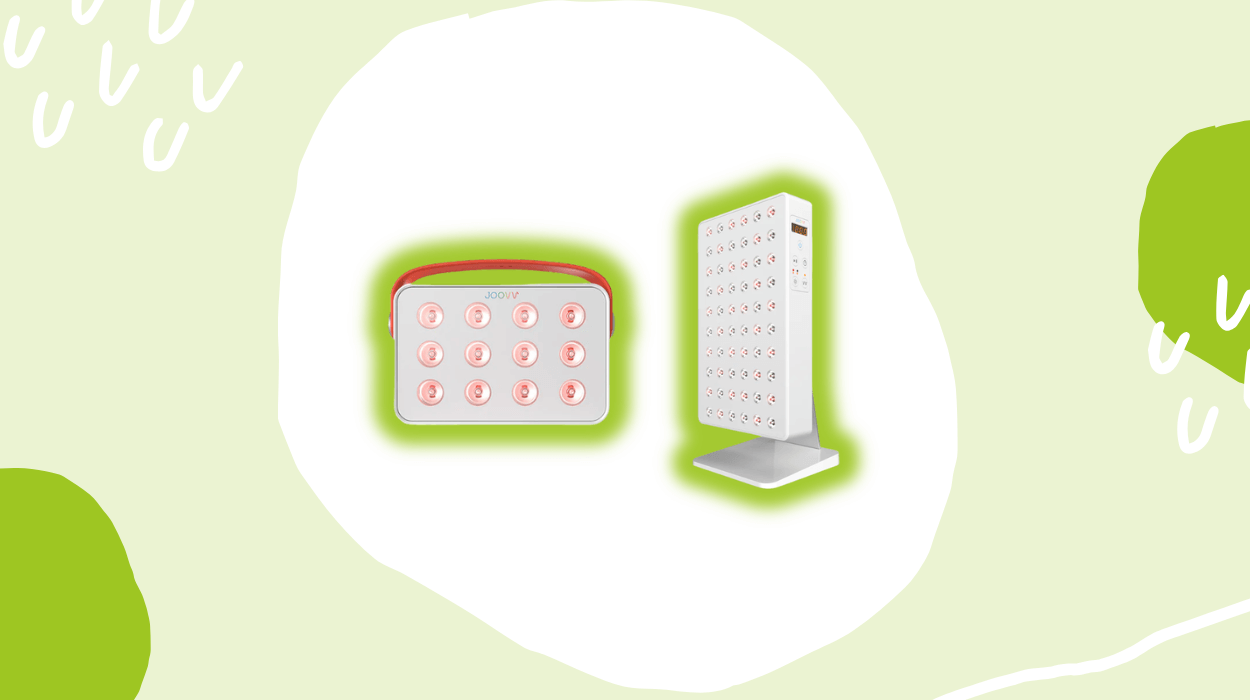

Joovv claims to specialize in medical-grade red and near-infrared light therapy devices. It offers compact, handheld units to modular full-body panel systems that can be physically expanded over time.
The brand claims to provide support for muscle recovery, joint comfort, and localized circulation. It also offers expansion kits, mounting systems, stands, and app integration.
This review will evaluate Joovv’s primary devices and customer sentiment trends. It will also assess strengths and limitations, and the depth of manufacturer-specific clinical validation, within the broader market.
Joovv is a light therapy company that makes devices meant for home use. These red light therapy devices may help you include light exposure in your routines. The product lineup includes both handheld and modular systems.
The Go 2.0 is a compact, portable device engineered for a targeted application. The brand also manufactures modular panel systems that can be expanded using its 3.0 Expansion panels. Generation 3.0 products are claimed by the makers to have undergone third-party testing and carry certification marks from Intertek, a Nationally Recognized Testing Laboratory.
The makers also state that their hardware is protected by multiple U.S. and international patents. Listed coverage includes panel systems such as the Original, Mini, Solo, Half-Max, Duo, Max, Quad, Elite, and Go models, including various 3.0 iterations, as well as mounting systems and stands.
Go 2.0 is a handheld device that emits red light at approximately 660 nanometers and near-infrared light at approximately 850 nanometers. Red light mainly affects surface tissues such as skin, while near-infrared light penetrates more deeply into muscle and joint tissue. The light interacts with cells through a process known as photobiomodulation. Specific wavelengths are absorbed by components inside the mitochondria, including cytochrome c oxidase. This interaction can influence cellular energy production, affect local blood flow, and alter signaling pathways related to inflammation. The device is intended to provide temporary relief of minor muscle pain, joint pain, minor arthritis pain, muscle spasms, temporary muscle relaxation, and temporary increases in local circulation.
The unit is battery-powered and designed for localized areas. Its emission area limits use to the knee, shoulder, lower back, or face. Dual-chip LEDs emit both red and near-infrared wavelengths from the same lens. The device operates without a fan and produces no operating noise. Bluetooth connectivity allows control through the mobile app, where session timing, battery status, and pulsed light settings such as Recovery+ mode can be adjusted. Included components are the handheld unit, a travel case, a 9V power adapter, a user manual, and protective eyewear to reduce direct eye exposure.
Mini is a single-panel system designed for sectional body support. It emits red (~660 nm) and near-infrared (~850 nm) wavelengths across a wider vertical surface than a handheld device. The broader beam area may provide support for regional tissue exposure, such as the upper torso or lower body, allowing simultaneous stimulation of skin and underlying musculature within one anatomical zone. It supports pulsed light (Recovery+ mode), modular expansion, and multiple mounting options.
The Solo 3.0 device is larger than the Mini model and provides broader coverage, but it remains a single-panel system. The device might help influence cellular energy production, local blood circulation, and inflammatory signaling. Its main features include dual-wavelength LED light delivery, pulsed light functionality, Bluetooth connectivity, modular connection capability, and multiple mounting configurations.
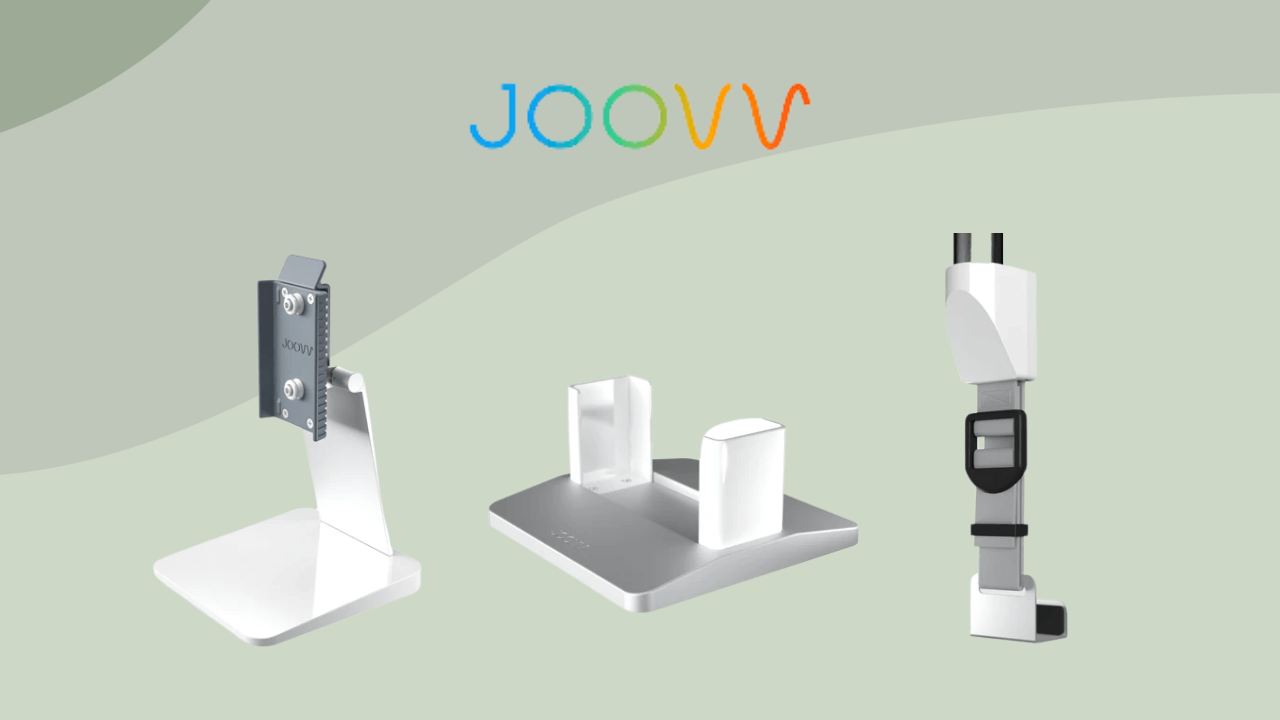
The package includes the Solo 3.0 panel, the selected mounting system (Mobile Stand, Boot Floor Stand, Door Mount System, or Nano Wall System), a power supply, protective eyewear to reduce direct eye exposure, and a user manual. The Solo 3.0 is expandable and can connect with additional panels to form Half-Max, Duo, Max, Quad, or Elite 3.0 configurations, increasing total coverage.
Half-Max is made from one Mini 3.0 and one Solo 3.0 combined into a single vertical setup. It provides more extensive coverage than a single panel and is intended for near full-body exposure from the front or back in one position. The system emits red light that affects surface tissues such as skin, while near-infrared light penetrates deeper into muscle and joint tissue.
It may help provide temporary relief from minor muscle pain, muscle spasms, temporary muscle relaxation, and temporary increases in local circulation.
Duo 3.0 is a two-panel red and near-infrared light therapy system designed for moderate to large areas. It provides more coverage than a single-panel setup and is intended for broader front or back body exposure in one position. The wider and taller exposure allows concurrent support for larger anatomical regions, increasing the amount of tissue receiving mitochondrial stimulation during each session. Setup options include the Door Mount System, Nano Wall System, Mobile Stand, and Boot configuration, depending on selection.
The package includes two connected panels configured as the Duo 3.0 system, the selected mounting system, power supplies, protective eyewear to reduce direct eye exposure, and user documentation. The Duo 3.0 is expandable and can connect with additional panels to form Max, Quad, or Elite 3.0 configurations for increased full-body coverage.
The Quad 3.0 is built from four Solo panels, creating extended vertical coverage with uniform panel height. The consistent panel dimensions allow even distribution of light across upper and lower body muscle groups, including the cervical and thoracic paraspinals, shoulders, chest wall musculature, gluteal muscles, quadriceps, hamstrings, and calves. The system may deliver red and near-infrared (~850 nm) wavelengths across all panels and supports pulsed mode and modular mounting.
The Max 3.0 consists of four panels arranged vertically. This configuration delivers full-body exposure from head to foot in a single standing position. The illuminated surface area may allow simultaneous exposure of major muscle groups, including the trapezius, deltoids, pectorals, latissimus dorsi, spinal erectors, abdominals, gluteus maximus, quadriceps, hamstrings, and gastrocnemius/soleus complex. It emits red (~660 nm) and near-infrared (~850 nm) light across all panels, includes pulsed functionality, and app control. The package includes two Mini 3.0 panels, two Solo 3.0 panels, the selected mounting system, power supplies, protective eyewear to reduce direct eye exposure, and user documentation.
The Elite is composed of six Solo panels connected vertically, forming the largest configuration in the lineup. The increased height expands coverage to the full posterior or anterior kinetic chain in one position, including the upper trapezius, rhomboids, pectorals, latissimus dorsi, gluteals, hip flexors, hamstrings, and lower leg musculature. As these muscle groups can be exposed at the same time, large portions of the musculoskeletal system receive light simultaneously. The system emits red light at 660 nm wavelength and near-infrared at 850 nm wavelength. With full-chain exposure, this may provide potential support for overall muscle recovery, reduced minor muscle discomfort, improved tissue oxygenation, and temporary increases in blood flow across multiple muscle groups.
Joovv states that its hardware ecosystem is built on a patented modular architecture across the 3.0 lineup, including the Solo, Mini, Half-Max, Quad, and full-body Max/Elite systems. The devices share standardized panel dimensions, synchronized digital controls, and compatible mounting systems. This allows panels to physically connect and operate as one coordinated unit.
The brand claims to hold multiple U.S. utility and design patents covering panel configurations, expansion frameworks, and mounting solutions. These protections extend to accessories such as the Door Mount, Nano Wall, and Mobile Stand systems. The company states that its linking mechanism enables vertical stacking while maintaining synchronized wavelength output, intensity, and timing across connected panels. This positions the product line as a scalable hardware platform rather than a collection of standalone devices.
The modular design creates a defined upgrade path. Users can begin with a single panel and expand to half-body or full-body coverage without replacing the original unit. The company claims that expansion maintains output consistency, unified controls, and mounting compatibility, reducing redundancy. Once connected, panels function as a single integrated system instead of independent devices.
The following are the published U.S. utility and design patents shared by the brand on its official site:
| U.S. Utility Patents | U.S. Design Patents |
|---|---|
| 10,828,505 C1 | D1004789 |
| 10,478,635 C1 | D1004790 |
| 11,033,752 B2 | |
| 11,524,172 B2 |
Joovv states that its hardware is engineered within established electrical safety and quality management frameworks commonly applied to medical electrical equipment. Across the Generation 3 lineup, including the Solo, Mini, Half-Max, and Quad models, the company standardizes red light at 660 nm and near-infrared light at about 850 nm. It also publishes irradiance ranges, recommended treatment distances, and session durations to provide measurable performance parameters. The company reports that its devices undergo independent third-party testing through Intertek and carry the ETL safety certification mark. The company references compliance with internationally recognized standards and also cites manufacturing practices aligned with ISO 13485 quality management systems for medical devices.
This positioning indicates that the devices are built within a documented safety, testing, and quality-control structure. Published wavelength specifications and irradiance metrics allow for objective comparison across products. Integrated digital timers, calibrated LED arrays designed for uniform light distribution, and internal cooling systems for thermal regulation reflect a controlled engineering approach.
These are the stated standards followed by the brand as per its official site details:
| Standards | What It Covers |
|---|---|
| IEC 60601-1 | Electrical safety and core performance requirements for medical equipment |
| IEC 60601-1-11 | Safety requirements for equipment used in home environments |
| IEC 62471 | Light safety and protection from photobiological risk |
| ISO 13485 | Quality management system for medical device manufacturing |
Joovv does not extend into adjacent recovery modalities such as PEMF therapy, compression devices, cold exposure systems, infrared saunas, or integrated recovery hardware. It does not operate a proprietary biometric tracking platform that connects session data with wearables like Apple Health, WHOOP, or Garmin. The ecosystem remains hardware-centric rather than digitally integrated or multi-modality. This means the brand functions as a dedicated light therapy option rather than a comprehensive recovery platform.
The company does not provide cross-modality integration that consolidates multiple recovery technologies, such as compression, cold therapy, and biometric tracking, within a unified brand environment. There is no built-in performance dashboard, practitioner-facing protocol software, or subscription-based programming to aggregate session metrics with recovery data. While specialization reinforces clarity around photobiomodulation, it limits ecosystem breadth and requires supplementation with external tools or brands for a fully integrated recovery workflow.
Kineon positions itself as a joint-focused recovery company centered on non-invasive pain relief, mobility restoration, and inflammation reduction. Its messaging consistently highlights options to manage concerns regarding osteoarthritis, chronic joint pain, injury recovery, and athletic overuse. The brand emphasizes restoring functional movement. Joovv positions itself as a medical-grade red light therapy wellness brand. Its messaging extends beyond joint pain to include muscle recovery, skin health, sleep support, cognitive function, and cellular health. The positioning is broader, wellness-oriented, and less condition-specific.
Kineon’s core design philosophy revolves around wearable, targeted therapy. The MOVE+ Pro is a strap-based, modular device that attaches directly to joints. It is battery-powered, hands-free, and engineered for localized treatment. Precision targeting is central to its product identity. Joovv’s architecture is panel-based and scalable. Devices range from handheld units to large modular panel systems that can expand into full-body configurations. You can typically stand in front of the device rather than attaching it to a specific body part. The focus is surface-area coverage rather than joint-specific targeting.
Kineon emphasizes a combination of 808nm near-infrared lasers and 660nm red LEDs. The brand highlights deeper tissue penetration and differentiates itself from LED-only systems by promoting the laser component as a performance advantage. Joovv focuses on high-output LED technology engineered to medical-grade specifications. It highlights UL-listed components, Nationally Recognized Testing Laboratory certifications, and third-party testing (Intertek).
The official site of Kineon also highlights concerns related to chronic inflammation, knee injuries, back pain, neck pain, shoulder pain, ankle pain, elbow pain, hip pain, and post-workout recovery. The primary focus appears to be orthopedic and musculoskeletal. Joovv promotes a wider range of use cases, including muscle recovery, joint support, skin health, sleep quality, cognitive support, and cellular optimization. The usage can extend beyond orthopedic concerns into general fitness and performance enhancement.
Kineon expands its ecosystem through complementary recovery tools such as the RELIEF+ Trigger Point Therapy Tool and an Extender Strap. It offers bundled systems like the Pain to Possible Bundle and the Total Relief Duo to create an integrated joint-and-muscle recovery solution. Joovv’s lineup includes the Go 2.0, Mini 3.0, Solo 3.0, Half-Max 3.0, Duo 3.0, Max 3.0, Quad 3.0, and Elite 3.0, along with stands, door kits, docking systems, and expansion panels.
Kineon’s flagship device is positioned in the mid-tier pricing range, typically between $499 and $699. The company strongly promotes HSA/FSA eligibility. Joovv’s pricing ranges from approximately $549 for handheld units to over $11,000 for high-end full-body modular systems. The company emphasizes financing options such as Affirm, Shop Pay, and Afterpay. HSA/FSA eligibility is available but not positioned as a primary strategy.
For increased personalization, Kineon highlights a Pain Quiz that delivers insights and provides a downloadable report. It is centered on diagnosing pain points and guiding you toward joint-focused options. Joovv provides a Buyer’s Guide and product selection assistance to help you choose the appropriate panel configuration. The approach focuses on matching device size and coverage to user goals rather than diagnosing pain conditions. Kineon offers devices that can be used on the go and are customizable, while Joovv is more focused on stationary, whole-body offerings.
Mito Red Light LLC and Joovv, Inc. reveal two distinct strategic models operating within the same red and near-infrared light therapy category, but with different structural priorities.
The brand Mito emphasizes wavelength diversity, hardware transparency, and tiered performance escalation. It highlights IEC 60601 medical electrical standards, FDA registration, FCC/RoHS/CE compliance, third-party spectral and irradiance testing, and a 3-year warranty across major panel lines. Joovv, by contrast, centers on medical-grade engineering, UL-listed components, Nationally Recognized Testing Laboratory (NRTL) safety markings, and Intertek third-party certification for its Generation 3.0 devices, typically backed by a 1–2 year warranty depending on product class. Both emphasize safety and validation, but Mito focuses on granular performance specifications, whereas Joovv highlights independent safety certification and structural system integrity.
Mito structures its lineup in escalating wavelength tiers. Its MitoPRO+ Series operates with four wavelengths, 630nm, 660nm, 830nm, 850nm, with irradiance at six inches generally exceeding 130–175 mW/cm² depending on size. The MitoPRO X Series expands to six wavelengths, while introducing touchscreen controls and app integration, scaling to 900 lenses / 1,800 chips in larger units. The ADAPT 4.0 Series adds 670nm and 940nm and introduces eleven selectable modes. Joovv prioritizes modular expansion by stacking synchronized panels to increase surface area and total power output. It offers the Joovv Go® 2.0, along with Modular panels beginning with the Mini 3.0, Solo® 3.0, Half-Max, Duo, Max, Quad, and Elite. Mito increases spectral density and mode customization per device, while Joovv increases total body coverage through system scalability.
Mito offers entry-level tabletop devices, mid-tier panels, multi-wavelength advanced systems, wearable therapy products, and commercial infrastructure. Joovv remains concentrated within a modular panel ecosystem optimized for home and professional panel-based installations.
Product breadth underscores the divergence. Mito expands into specialized options, including the MitoGLOW™ LED Mask, MIND™ Helmet, BOOST™ Intranasal System, and QUAD™ Belt, along with BioPhotonic Skincare™ products under the MitoAURA™ line. Joovv does not extend into skincare formulations, helmets, intranasal systems, or wearable belts. Its accessories focus on stands, mounts, expansion hardware, and ecosystem synchronization.
Mito frames its devices around systemic wellness themes such as sleep, skin health, mood, and recovery. Joovv frames its products within a narrower regulatory posture, temporary relief of minor muscle and joint pain, increased local circulation, and topical heating. Both brands also offer mobile app integration. Mito integrates touchscreen and app functionality in higher-tier models such as the PRO X and ADAPT lines. Joovv enables synchronized control and programmable treatment sessions across modular panels.
To assess real customer sentiment toward Joovv, we reviewed user discussions on Reddit between 2024–2025. Across these discussions, feedback trends are predominantly negative, with recurring concerns focused on customer service, pricing, and product performance, particularly regarding the Mini 3.0.
The customer service complaints appear to be consistent. Some users claim that safety-related questions about device positioning, usage duration, or EMF exposure were met with vague responses, which they say reduced confidence in the brand. The tone reflects sustained frustration with post-purchase communication.
Warranty and return policies are heavily criticized, particularly given the premium pricing of many devices, which often exceed $1,000. Users in the referenced threads describe strict return windows, restocking fees, and what they characterise as difficult warranty claim processes.
Product reliability concerns focus most prominently on the Mini 3.0. Users report device failures after limited use, loud cooling fans, concerns about EMF levels, and limited wavelength offerings, commonly cited as 660nm and 850nm only. While some mention experiencing initial benefits from red light therapy, such as perceived skin or recovery improvements, these positive remarks are often overshadowed by dissatisfaction related to hardware durability or service interactions.
The overall Reddit discussions reflect a strongly critical sentiment towards the brand among users. The themes include dissatisfaction with customer support responsiveness and concerns about product durability relative to price. While some users acknowledge initial benefits from red light therapy itself, it's essential to carefully evaluate technical specifications and refund policies before exploring the brand.
As part of this evaluation, we looked for the brand on BBB, where it is not BBB-accredited and currently holds a B+ rating. Over the past years, complaints have been filed, with some closed within the last few months. The profile also reflects 10+ customer reviews.
Complaint patterns include strict enforcement of return-condition standards, partial refunds tied to alleged product damage, refusal to sell individual replacement parts, and limited access to live customer support. Many shared frustration with email-only communication channels and delays in resolution timelines.
Product-related grievances also appear in the records. Reported issues include control interface malfunctions, Bluetooth connectivity problems, module failures, and dissatisfaction with installation or configuration complexity. While the brand’s response activity appears to be consistent, several people shared experiencing friction in post-purchase management. The brand’s rating reflects structured complaint acknowledgment, but the low average review score and recurring service-policy disputes highlight potential post-purchase experience risks.
Joovv highlights scalable panel architecture through its near-infrared devices. It's standardized 660 nm (red) and 850 nm (near-infrared) wavelengths, synchronized digital controls, and patented expansion systems allow you to build from a single panel to full-body configurations. The company also emphasizes formal safety alignment, including third-party testing, ETL/NRTL listing, and structured manufacturing standards.
However, the brand remains spectrally narrow and currently does not offer broader wavelength collections. Usage guidance also draws from general light therapy literature rather than manufacturer-validated frameworks specific to each configuration.
The company focuses on structural scalability and safety compliance within the red light therapy category. It delivers standardized dual-wavelength output and modular system growth, but its long-term value proposition depends heavily on durability, service experience, and the degree to which you are comfortable relying on general photobiomodulation research.

Contact us at [email protected] or follow @leafsnap on Twitter! View our Privacy Policy.