


Function Health is a membership-based fitness platform built around testing and long-term fitness visibility rather than episodic care. It aims to create a more complete baseline of your internal fitness than what is typically captured during routine annual checkups.
The brand focuses on giving you access to an extensive set of diagnostic tools that assess areas such as metabolic health, cardiovascular markers, hormones, nutrients, inflammation, immune activity, and organ function.
In this review, we take a closer look at Function Health’s core offerings, how its approach compares to similar testing platforms, and where the brand shows clear strengths. We will also examine consumer feedback and customer experiences to provide a balanced view of how the platform performs beyond its stated claims.
As per the official website, Function Health gives you access to extensive clinical testing, structured result interpretation, and ongoing fitness tracking, without relying on insurance or positioning itself as a medical provider.
The brand provides a comprehensive lab testing program that includes 160+ blood and urine tests each year, typically conducted twice annually.
Testing is completed at more than 2,000 Quest Diagnostics locations, using medical-grade laboratory infrastructure instead of at-home kits. This approach allows you to establish a personal baseline and monitor how key biomarkers change over months and years, supporting trend analysis rather than one-time snapshots.
According to the makers, Function Health organizes its testing across multiple fitness categories, including heart and metabolic health, hormones and fertility, thyroid function, immune regulation, autoimmunity, nutrients and electrolytes, liver and kidney health, pancreatic markers, stress and aging indicators, and biological age assessment.
Additional panels extend into environmental toxins such as lead and mercury, advanced lipid and cholesterol markers, inflammation indicators, and select genetically related risk markers. This category-based structure is designed to show how different body systems interact rather than presenting lab values in isolation.
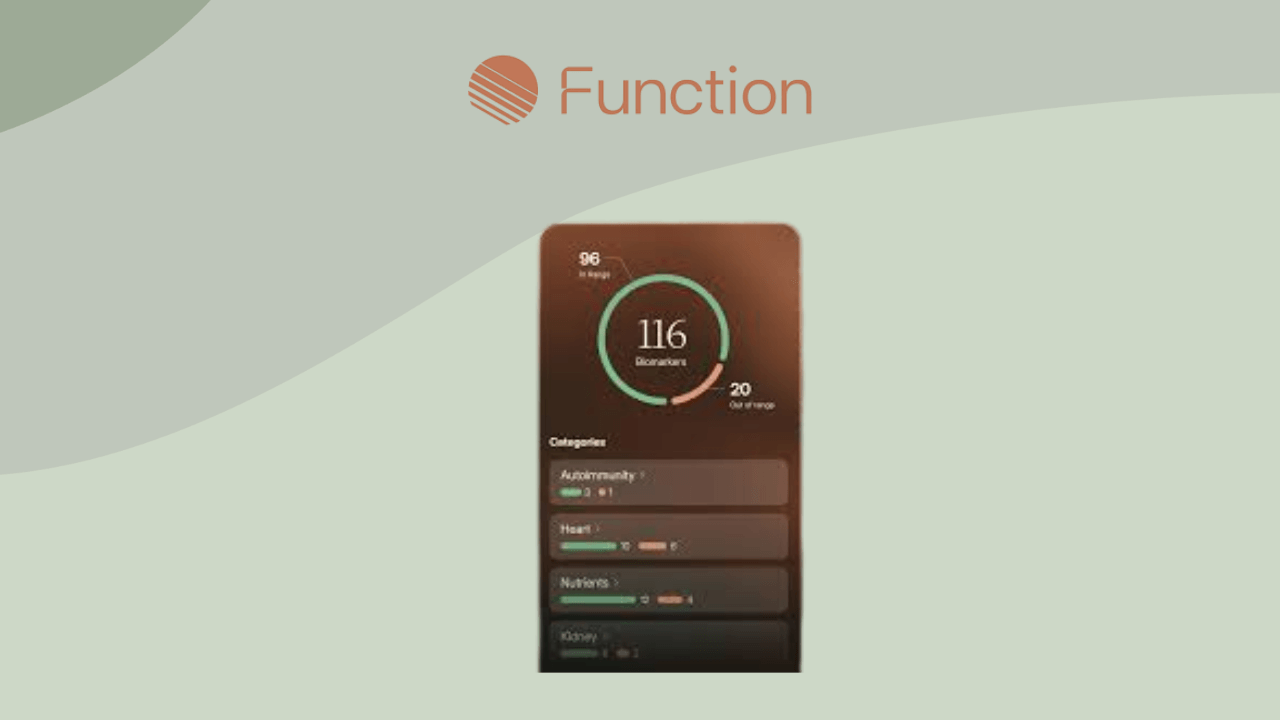
Function Health offers a broad panel of laboratory tests that focus on measurable biomarkers. These tests assess how different biological systems function by measuring specific molecules, enzymes, hormones, and cells circulating in blood or excreted in urine.
The platform’s cardiovascular panel centers on lipids and inflammatory markers such as LDL cholesterol fractions, Apolipoprotein B, triglycerides, and high-sensitivity C-reactive protein. LDL particles and ApoB reflect how cholesterol is transported in the bloodstream, with smaller, denser particles being more likely to interact with arterial walls. hs-CRP is produced by the liver in response to inflammatory signaling molecules, offering insight into low-grade systemic inflammation that can influence vascular health.
The panel also features Thyroid testing that includes TSH, free T4, free T3, and thyroid antibodies. TSH is released by the pituitary gland to regulate thyroid hormone production, while T4 and T3 control cellular energy use by influencing mitochondrial activity and gene expression.
Antibodies such as TPO and TgAb indicate whether the immune system is reacting to thyroid tissue, which can alter hormone availability even when hormone levels appear within range.
As per the official website, other lab tests include nutrient assessments, immune and inflammation markers, liver, kidney, and pancreatic enzymes, environmental toxin screening, and urine analysis. These tests quantify how nutrients act as enzyme cofactors, how immune cells and antibodies behave, how organs process and eliminate substances, and how the body maintains internal balance at a biological level.
Function Health positions itself around a longevity-driven fitness model and states an explicit mission to “empower you to live 100 healthy years.” The brand claims this approach is grounded in the premise that long-term healthspan may be better supported through early, comprehensive measurement of biological indicators.
According to the company, this model is intended to promote earlier visibility into potential health risks over the lifespan. Function Health states that its longevity framework is built on broad biomarker testing alongside imaging and scan-based assessments.
The platform claims to provide access to an extensive range of laboratory tests covering metabolic health, cardiovascular risk markers, inflammatory indicators, hormone levels, organ function, and nutrient status.
These measurements are described as tools to help surface deviations from reference ranges earlier than traditional testing schedules might allow. The addition of scans and imaging is presented as a way to complement blood-based data with additional physiological and structural context.
Function Health presents longevity as a data-oriented and longitudinal process rather than a one-time intervention. The platform claims users are able to monitor biomarkers over time, identify trends, and use repeated measurements to inform preventive health decisions.
Function Health claims to operate as an advanced fitness platform by combining whole-body laboratory testing, advanced imaging, and AI-supported Medical Intelligence within a single digital system.
According to the brand, the platform is designed to replace fragmented healthcare experiences by consolidating diagnostics, data interpretation, and long-term tracking into one unified interface.
Function Health claims that its platform is built around a centralized, HIPAA-compliant dashboard that aggregates data from multiple sources, including lab results, imaging, wearables, and uploaded medical records.
The brand states that you can review structured insights, access personalized food and supplement guidance, and download or share raw diagnostic data. This centralized design is positioned as a way to reduce fragmentation and give you a more complete and continuous view of their health status.
The company claims its Medical Intelligence system uses AI to analyze and connect otherwise disconnected data sources. According to Function Health, this system is designed to identify early warning signals, detect patterns and trends across biomarkers over time, and contextualize results across biological systems rather than presenting them in isolation. The platform also claims to offer AI-supported tools such as private AI chat and protocol guidance, drawing on published research and clinician input to provide context-aware insights.
Function Health further claims that its membership includes 160+ biannual lab tests, covering areas such as cardiovascular health, hormones, thyroid function, liver and kidney markers, inflammation, nutrient status, heavy metals, metabolic health, and overall organ function. In addition to lab testing, the platform claims to integrate advanced imaging, including MRI and CT scans enabled through its Ezra acquisition. These imaging services are described as using FDA-cleared, AI-assisted technology and are positioned to add structural and anatomical context alongside blood-based biomarkers.
The brand also claims that the platform’s design is influenced by the founders’ and team’s personal experiences with health challenges, including hormonal conditions, neurological issues, heavy metal exposure, autoimmune inflammation, and gaps encountered in traditional care models. According to the brand, these experiences informed an emphasis on user-owned data, transparency, longitudinal measurement, and proactive fitness management, rather than episodic or symptom-driven care.
Function Health requires you to attend an in-person laboratory visit to complete its lab testing, which is a core part of the service. Blood samples are collected at more than 2,000 Quest laboratory locations nationwide, with each appointment typically taking about 15 minutes.
This approach supports analytical accuracy, as venous blood draws performed in certified labs reduce pre-analytical variability compared with many home collection methods. This is especially important for biomarkers that are sensitive to handling conditions, such as hormones, lipids, and inflammatory markers.
However, this structure introduces logistical constraints. Most members need one to two lab visits per year to complete their testing panels, with two visits often required for more complex hormone measurements or for residents in certain states, such as Arizona, due to local collection and processing requirements.
While the visits are relatively brief, you must still schedule appointments, travel to a nearby lab, and coordinate timing around fasting or circadian considerations for certain tests.
Function Health’s access model requires an annual membership subscription priced at $499 per year, which includes prepaid access to a comprehensive panel totaling more than 160 lab tests spread across the year: 100+ biomarkers in the Annual Test and 60+ in the Mid-Year Test. These panels cover metabolic, cardiovascular, hormonal, nutrient, inflammatory, heavy metals, and other markers.
This subscription-based approach supports longitudinal fitness tracking by repeating the same biomarkers at planned intervals, which reduces the impact of normal biological variability and allows trends to be identified more reliably over time. It is particularly relevant for markers such as lipids, glucose regulation, thyroid hormones, and inflammatory indicators, where changes across months can be more clinically meaningful than a single isolated measurement.
Access to testing remains dependent on maintaining an active membership, with additional or targeted biomarkers outside the included panels offered as member-only add-ons at extra cost. There is no option for non-members to purchase one-off tests or small custom panels independently.
As per its official website, Fountain Life operates as a premium longevity and healthspan membership built around advanced diagnostics, in-clinic care, and continuous AI-driven interpretation. Its model is designed to identify disease risk well before symptoms appear and to support long-term optimization strategies tied to aging biology.
Meanwhile, Function Health follows a more standardized preventive testing model, concentrating on comprehensive lab coverage to help you establish, monitor, and compare long-term biological baselines without positioning itself as a longevity clinic or provider.
Fountain Life prioritizes diagnostic depth and clinical immersion. You may undergo whole-body imaging, blood biomarker analysis, and genetic screening, with testing intensity determined by membership tiers such as CORE, APEX, or EPIC. These diagnostics are interpreted through AI systems trained on extensive datasets and are paired with physician-led consultations.
Function Health emphasizes consistency and scale, offering 160+ lab tests performed up to twice per year through more than 2,000 Quest Diagnostics locations. As per its official site, advanced imaging and neurological assessments are available as optional add-ons rather than being embedded into the base membership.
Artificial intelligence functions differently across the two platforms. Fountain Life’s Zori AI serves as a continuously active medical assistant that integrates diagnostic results, genetics, wearable data, lifestyle inputs, nutrition patterns, and travel context to refine recommendations in real time. This creates a dynamic fitness model that evolves as new data is introduced.
Function Health applies AI primarily to support lab interpretation, longitudinal trend analysis, and clinician-reviewed insights, focusing on clarity and actionable understanding rather than continuous real-world data ingestion.
The care experience further distinguishes the brands. Fountain Life offers ongoing access to a multidisciplinary medical team that may include a longevity physician, nurse, nutritionist, health coach, and care coordinator, supported by on-demand care access. The process typically begins with a discovery call and continues through structured follow-ups.
Function Health maintains a lighter-touch model in which clinicians review results, flag concerns, and provide personalized protocols, while ongoing physician access and coaching are not positioned as core elements of the membership.
Fountain Life focuses on a longevity program that combines advanced diagnostics, continuous AI guidance, and direct clinical involvement. On the other hand, Function Health gives accessible, recurring, and comprehensive lab testing that helps you track biomarkers over time, identify early risks, and maintain a centralized fitness record.
Quest Health and Function Health both provide direct access to laboratory testing without requiring a traditional physician visit, but they differ in structure, depth, and how results are used over time.
As per its official website, Quest Health operates as a consumer-focused testing marketplace backed by Quest Diagnostics, allowing you to purchase individual lab tests or specific panels based on immediate needs. Function Health follows a membership-based model that emphasizes comprehensive testing, repeat measurement, and long-term tracking rather than one-time diagnostics.
Quest Health gives you control over what you test and when. You can choose from more than 100 lab tests across categories such as annual support, hormones, sexual health, fertility, nutrition, infectious diseases, and chronic condition screening. Sample collection can be completed at various Quest Diagnostics locations, through in-home collection services, or via select at-home kits. Results are delivered online once available, and you have the option to discuss findings with an independent physician after testing if additional context or plan discussion is needed.
Function Health takes a more structured approach. Your annual membership includes over 160+ lab tests, typically completed twice per year, with additional re-testing available for markers that fall outside optimal ranges. Testing covers heart health, metabolic function, hormones, immune regulation, nutrients, environmental toxins, biological age, and autoimmunity. Rather than selecting individual tests, you follow a predefined testing schedule designed to surface patterns and changes over time.
The way results are interpreted also differs. Quest Health primarily delivers fast access to lab data, leaving next steps largely up to you unless you choose to engage with an independent physician. This model works well if you already know what you want to measure or are monitoring a specific concern.
Function Health includes clinician review for every result, with notes that highlight what stands out, what has changed, and where follow-up may be useful. Results are paired with personalized food and supplement guidance and stored in a single dashboard that supports long-term comparison.
Advanced testing and imaging further separate the two offerings. Quest Health focuses on laboratory diagnostics, including curated panels like the Elite Health Profile, which measures more than 85 indicators related to inflammation, cholesterol, blood sugar, liver and kidney function, hormones, and immune health.
Function Health includes optional add-ons such as GRAIL testing, advanced MRI scans, and CT imaging, along with extended panels for areas like heart risk, Alzheimer’s risk, and gut health.
Pricing also reflects these brand models. Quest Health follows a pay-per-test structure, with many tests priced under $200, frequent promotions, payment plans through Klarna and Affirm, and FSA or HSA eligibility for many services. You pay only for the tests you choose.
Function Health charges a flat annual fee of around $499, billed once per year, which covers prepaid access to its core testing schedule and platform features. Advanced imaging and specialty add-ons require additional payment. Insurance is not required for either service.
Quest Health offers flexibility, affordability, and the ability to order specific lab tests on demand with minimal commitment. Function Health follows a structured, ongoing view of your fitness, with repeated testing, clinician-reviewed insights, and tools designed to track trends and changes over time.
Based on Trustpilot reviews published primarily in November–December 2025, our evaluation of Function Health reflects a balance between the perceived value of its testing model and the consistency of its service execution. The brand has received a 4.3 rating, which is based on 500+ reviews.
Some users describe the platform as informative and reassuring, noting that access to a wide range of blood markers helped them better understand their fitness status and identify areas that had not been previously addressed.
Many customers view the scope of testing as a practical alternative to self-pay lab work, particularly when results are used to inform lifestyle or follow-up discussions with external healthcare providers.
At the same time, a few users raise concerns around administrative clarity. Recurring themes include confusion about billing cycles, limited advance notice around renewals, delays in refunds, and a cancellation process that feels more involved than expected.
Several customers also report operational challenges linked to lab coordination, such as multiple draw visits, delayed results, or difficulty completing testing due to external lab constraints. These experiences suggest that while the testing framework is comprehensive, supporting processes are not always consistent.
Support access and platform usability further influence the overall assessment. Some users note that issues were resolved through email-based support, while others express dissatisfaction with automated chat systems. A few users also point to usability limitations, including unclear guidance on testing intervals, difficulty exporting full reports, and occasional friction within the app interface.
Our evaluation indicates that Function Health provides proactive access to detailed data analysis. When testing, reporting, and billing function as intended, many customers find the service informative and worthwhile. However, ongoing concerns around customer support accessibility, billing transparency, and operational reliability remain notable considerations.
Our evaluation of Function Health focuses on brand age, operating structure, and third-party trust indicators rather than promotional positioning. The focus an annual membership model that provides access to broad blood testing panels covering metabolic, cardiovascular, hormonal, and inflammatory markers, along with digital summaries designed to help you track trends over time.
To assess consumer trust and complaint patterns, we reviewed records from the Better Business Bureau, where it currently holds a C- rating and is not BBB accredited. Over the past years, many complaints have been reported, frequently mentioning billing disputes, refund handling, auto-renewal charges, and access limitations tied to lab availability or testing timing.
While many cases show that the company ultimately issues refunds or resolves disputes, these outcomes often follow formal escalation, which weighs into the overall assessment.
This evaluation suggests that Function Health’s preventive testing model aligns with growing interest in data-driven health insights, but its BBB history highlights ongoing challenges around clarity, customer support responsiveness, and expectation-setting.
Function Health follows a measurement-focused model built around repeat laboratory testing and long-term data tracking. The brand frames its offering around continuity and centralized data access.
At the same time, this structure introduces practical limitations. You need to commit to an annual membership and complete in-person lab visits, which may reduce flexibility if you prefer occasional testing or at-home sample collection. The volume of data can also require careful interpretation, since out-of-range results may reflect short-term physiological variation rather than sustained change.
Before considering Function Health, it might be helpful to maintain consistent testing conditions to support accurate trend comparison and avoid concluding single data points. You should also account for the ongoing commitment required by the subscription model. The platform may suit you if you value structured, long-term data collection and understand the limits of biomarker tracking without direct diagnostic or procedure support.

Contact us at [email protected] or follow @leafsnap on Twitter! View our Privacy Policy.