
Glow is a digital health platform focused on reproductive and family health, offering tools for cycle and fertility tracking, pregnancy and postpartum support, connected health devices, and AI-powered features.
The brand's products and services are designed around fertility awareness, cycle tracking, pregnancy monitoring, and postpartum care, with its ecosystem extending across apps, wearable and connected devices, and digital health tools.
In this review, we look at the brand’s product range, digital features, privacy practices, customer experiences, and reputation. We also consider how its approach compares with similar brands and whether its combination of tracking tools, connected products, and digital support offers meaningful value.
Launched in 2013 under HVF, a startup founded by Max Levchin, Glow focuses on reproductive health tracking through data-driven technology and machine learning. Its services extend across tracking apps, including Ovulation Tracker, Nurture, Baby Tracker, and Eve Period Tracker. The brand also offers a wearable breast pump, a basal thermometer, ovulation test strips, pregnancy test strips, and bundled fertility products.
Beyond these, the brand’s Premium subscription expands its ecosystem with advanced charting, personalized plans, comparative insights, profile customization, ad-free app access, and access to GlowGPT AI support across the complete app family.
The brand also claims that medical advisors from specialties like obstetrics, reproductive endocrinology, neonatology, pediatrics, and women's health contribute professional guidance across different areas of the platform.
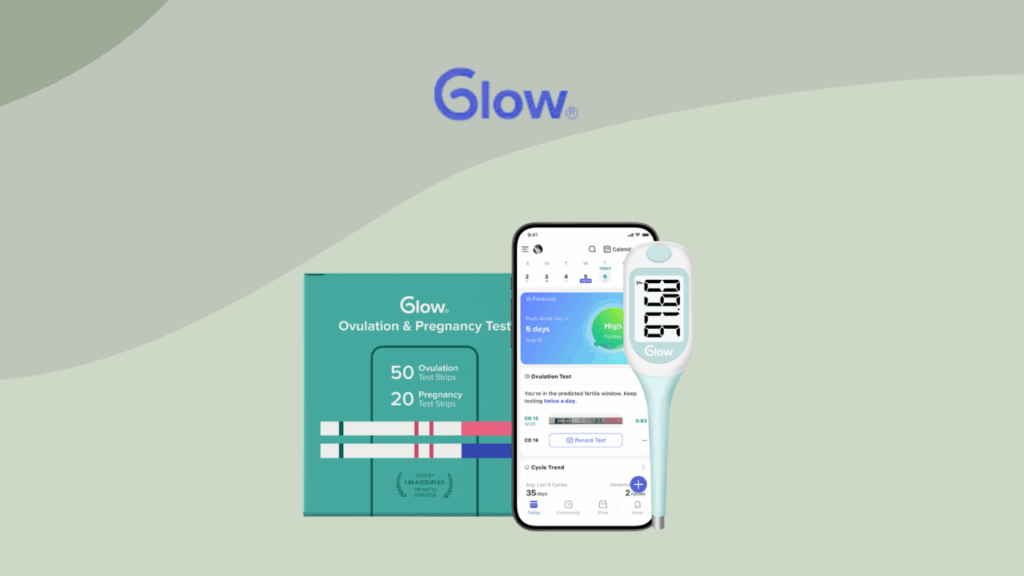
The Smart Basal Body Thermometer is a wearable device designed to track basal body temperature (BBT) for fertility awareness and cycle tracking. It records temperature at the same point each morning and stores the data in the app for trend analysis. After ovulation, rising progesterone is associated with a small increase in basal body temperature, which can appear as a sustained shift in the temperature record. The app can then combine these temperature trends with cycle information to support fertility tracking.
The Fertility Bundle combines tools for monitoring ovulation, detecting pregnancy, and tracking basal body temperature. According to its official website, the bundle includes 20 Pregnancy Test Strips, 50 Ovulation Test Strips, one Smart Basal Body Thermometer, and a one-year premium membership.
The ovulation strips work by detecting luteinizing hormone (LH) levels in the urine. LH normally rises sharply before ovulation and helps trigger the final stages of follicle maturation and egg release. Tracking this rise can indicate that the fertile period is approaching, although an LH surge does not confirm ovulation.
As part of the bundle, the pregnancy test strips detect rises in human chorionic gonadotropin (hCG) levels, which are produced after implantation as placental tissue develops. Results from both strips are scanned through the app, which provides separate color-coded charts, tracks hormone trends, and pairs them with cycle information for simple interpretation.
Smart Breast Pump is intended for milk expression while allowing normal movement during pumping. According to its official website, it offers suction intensity up to 300 mmHg, 12 adjustable suction levels, four pumping modes, and a 6-ounce (180 ml) milk capacity per side.
Bluetooth connectivity allows pumping data to sync with the Baby app, including session start time, duration, and collected milk volume. Each full charge provides about 150 minutes of operation, equivalent to five 30-minute sessions. The wearable design is intended to fit under clothing, with a leak-proof milk collection system and wash-friendly components.
The Smart Breast Pump works by creating rhythmic negative pressure around the nipple via its flange, which promotes the release of prolactin, a hormone that supports milk synthesis in the mammary glands. It also stimulates oxytocin release, which causes contraction of myoepithelial cells surrounding the alveoli and helps move milk into the ducts for expression.
The platform’s digital services are based on a network of four interconnected apps that could help track different stages of reproductive health, pregnancy, and early motherhood. For instance, the Ovulation Tracker app is intended for menstrual cycle and ovulation tracking, with fertility tools that help estimate the fertile window and ovulation date. The Nurture app focuses on pregnancy and allows you to track pregnancy progress, due dates, symptoms, appointments, and baby growth.
The Baby app focuses on newborn care, integrating tracking of metrics such as feeding, breastfeeding, and pumping, sleep, and diaper changes. Eve Period Tracker app could help track periods, menstrual cycles, symptoms, moods, and sexual activity. The brand offers more than 20 charts and analysis features for examining health patterns and trends across periods, fertility, pregnancy, and newborn care.
The AI-based service is provided through GlowGPT, which is available with the premium membership. It may help answer questions about women’s health and baby care, including fertility, pregnancy, postpartum topics, newborn care, breastfeeding, sleep, periods, and ovulation.
Glow’s ecosystem consists of four apps that cover different stages of reproductive and early family care. The Ovulation Tracker app focuses on tracking ovulation windows, Eve tracks periods, the Nurture app covers pregnancy-related metrics, and Baby supports infant care tracking. The platform also provides partner connection features during fertility tracking, including shared alerts, shared calendars, and daily health logs for both partners.
The same setup extends to the brand’s hardware and related offerings, including the Pregnancy Test Strip, Smart Basal Body Thermometer, Smart Breast Pump, and Ovulation Test Strip. You can connect these devices with the relevant app functions, linking tracking across fertility and postpartum stages. Such integration provides the ability to keep one account and data history as you move from cycle tracking to conception, pregnancy, and early parenting.
According to its official website, Glow highlights a medical advisory board that includes Dr. Ari Brown, Dr. Philip E. Chenette, Dr. Tamer Seckin, Dr. Jane Chueh, and Dr. Tamer Seckin. They have expertise across areas like pediatrics, reproductive endocrinology and infertility, maternal-fetal medicine, neonatology, and clinical informatics.
The brand states that its educational content and articles published within its suite of apps are reviewed by these independent medical experts before undergoing internal cross-checking for accuracy and relevance. It gives you medical oversight behind the educational information you encounter while using the platform. The review process can also provide useful context alongside the brand’s tracking tools, particularly when you're trying to understand reproductive health information instead of simply recording the cycle data.
Glow has a documented history of privacy and security issues. In 2020, the California Attorney General reached a settlement with the brand over failures related to safeguarding sensitive health data, insecure password change processes, and risks of unauthorized access. These concerns are particularly significant as the brand handles highly sensitive reproductive and fertility information, including details related to menstrual cycles, fertility, and pregnancy.
External privacy assessments from reputable organizations like the Mozilla Foundation and Consumer Reports have also raised concerns about how the platform handles sensitive reproductive data. Such security failures and continued privacy concerns may lower confidence in the brand’s privacy practices and data handling claims.
When comparing Clue and Glow, both brands operate across the femtech space and focus on reproductive health and menstrual health tracking, but their core structures, service breadth, and priorities differ. Clue's scope extends across the reproductive journey from the first period through conception, pregnancy, and perimenopause. Glow was launched in 2013 and follows a broader reproductive and family health model, covering fertility, pregnancy, baby tracking, and period tracking through a dedicated app ecosystem, which is paired with complementary products.
Clue maintains most of its services within one primary app, with different modes covering period tracking, conception, pregnancy, and perimenopause. Its core period tracking experience includes cycle statistics, predictions, symptom tracking, and fertility-related information. The brand's Plus subscription expands the experience through advanced cycle insights, pattern analysis, expanded tracking customization, expert content, and Clue Connect, which allows cycle information to be shared with a loved one.
Glow provides a broader service structure, featuring apps like Nurture, Eve Period Tracker, Ovulation Tracker, and Pregnancy Tracker. The premium subscription extends across this app family and includes features like access to GlowGPT AI, premium articles, comparative insights, advanced charting, and an ad-free experience. The platform's services further extend into physical products through the Glow Shop, including the Smart Breast Pump, Smart Basal Body Thermometer, Ovulation Test Strips, and Pregnancy Test Strips.
The differences are also evident in how the brands approach technological integration, research, and data privacy. Clue places strong emphasis on its science-based approach and privacy standards, stating that app data is protected under German and European Union privacy laws. The brand also outlines collaborations with reputed institutions like Oxford, Berkeley, and MIT, with cycle predictions described as evidence-based.
Glow places greater visible emphasis on technological features such as access to the GlowGPT AI, advanced charting, comparative insights, partner connected tracking. Its official website also states that it does not sell personal information or data without consent. The platform also allows data deletion, consent withdrawal, personalized advertising opt-out, and an Offline Data Protection option that removes designated key health data from Glow's servers while retaining it on the personal device.
Clue gives you a more consolidated reproductive-health tracking experience with a stronger visible emphasis on research and privacy. Glow offers a broader digital and physical ecosystem, with more app-specific features and connected products.
Ovia Health and Glow both offer tracking across reproductive health, fertility, pregnancy, and family health. However, they have nuances in their service structure, technology approach, and community model.
In terms of service breadth, Ovia offers a single Ovia app to track the menstrual cycle, fertility, pregnancy, postpartum, and perimenopause or menopause tracking, along with Ovia Pregnancy for tracking pregnancy milestones, symptoms, and baby development information. Beyond these apps, the brand offers access to personalized health programs, Care Team access, coaching, and employer and health plan programs.
Glow divides its core app range across the Nurture, Glow Baby, Ovulation Tracker, and Eve Period Tracker apps. These apps help track metrics around fertility and ovulation windows, pregnancy, infant development, and period tracking. It also offers a Fertility Program that provides access to fertility clinics and pricing arrangements involving IVF, IUI, ICSI, egg freezing, and related medication. The brand also integrates hardware tracking through offerings like the Smart Breast Pump, Test Strips Bundle, and Smart Basal Body Thermometer.
Partner participation presents another difference in how the two brands structure shared access. Ovia allows you to invite a partner, family member, friend, or caregiver to follow your journey, and its privacy policy states that invited followers can access personal data contained within the account. Glow presents partner participation more directly through connected accounts. It allows you to invite a partner so that both accounts can share information, daily logs, fertility alerts, cycle information, individual health profiles, and tailored fertility insights. Some health logs can also remain hidden from partners.
Community also separates the two brand models. Ovia includes community features, but its broader experience emphasizes clinically reviewed articles, personalized programs, health tracking, and professional support. Glow gives peer interaction a more prominent role through a large community that the brand states includes more than 25 million women worldwide. Its forums cover discussions around fertility, pregnancy, relationships, parenting, and other reproductive health subjects, allowing personal tracking to operate alongside discussion and shared experiences.
Ovia is the stronger fit when you want tracking to sit alongside personalized programs and professional support. Glow has more to offer when you want your tracking experience to extend into fertility services, connected products, and a larger community.
In evaluating Glow's brand credibility, we looked at its operating history, privacy record, and third-party evaluation metrics. The brand has a longstanding presence in reproductive health tracking, but its credibility is affected by past privacy and security concerns. These include a 2020 settlement with the California Attorney General involving security vulnerabilities and medical privacy law violations, along with a separate API vulnerability that exposed user information. The brand also has limited visibility on review platforms such as Trustpilot and the Better Business Bureau. It appears to have an established position in the reproductive health tracking market, but its history of privacy and security issues remains an important part of how you should view the brand's credibility today.
For assessment of Glow, we looked at the ratings and feedback available through the Google Play Store and Apple App Store. These sources provided insight into how the brand’s apps performed in everyday use and which aspects of the experience require consistent attention.
The available ratings are generally positive across its apps. On Google Play, the Pregnancy Tracker App holds a 4.0 out of 5 rating from more than 29,000 reviews, while the Baby Tracker App has a 4.4 rating from 14,000+ reviews. The Apple App Store shows similar results, with the Nurture App rated 4.8 out of 5 from more than 30,000 reviews and the Eve Period Tracker rated 4.7 out of 5 from over 114,000 reviews.
The available feedback highlights the practical tracking functions offered across these apps. Areas like pregnancy development, menstrual cycle tracking, sleep, caregiver sharing, and educational resources received positive mentions. However, some feedback raises concerns about frequent advertisements, recurring upgrade prompts, and certain app features restricted to paid subscriptions.
Technical and account-related issues also appear across the shared feedback. Some users reported app performance problems, difficulties with login or account recovery, occasional loss of stored data, and slow synchronization between caregivers. Reactions to the platform’s community discussions are also varied, with some users finding these spaces useful while others raise concerns about conversation quality or moderation.
Our evaluation notes that the brand's services are well received for their range of everyday tracking functions, although the user experience varies depending on access to paid features and the reliability of individual app functions.
Glow features a connected app and product ecosystem that helps track menstrual cycles, fertility, pregnancy, and infant care metrics. Its medical review process, partner tracking features, and Offline Data Protection mode add further depth to the platform.
However, access to app features like advanced charting, deeper analysis, GlowGPT AI, and ad-free access requires a premium subscription, which adds an ongoing cost.
While the brand emphasizes broad reproductive and family health tracking, app predictions, and recorded patterns remain supporting information and do not constitute a medical diagnosis of pregnancy or menstrual issues. Persistent symptoms, ovulation and pregnancy concerns, or queries still require consultation with a licensed doctor.

Contact us at [email protected] or follow @leafsnap on Twitter! View our Privacy Policy.