

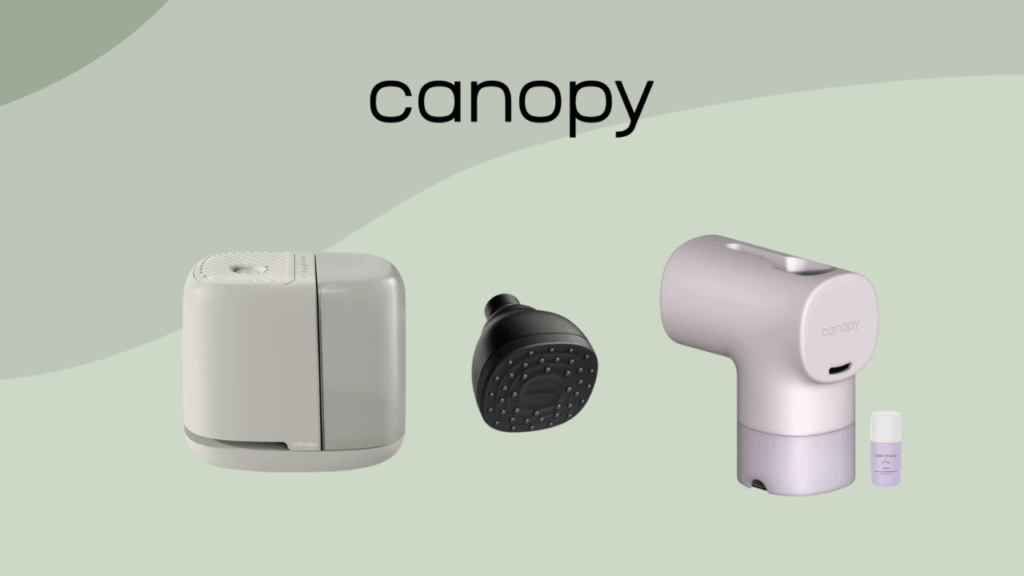
Canopy focuses on improving skin, hair, and comfort by enhancing air and water quality in everyday environments. The brand’s product range includes bedside and portable humidifiers, filtered showerheads, and aroma diffusers. The offerings are suitable for use in bedrooms, nurseries, and daily routines.
In this review, we examine some of the brand’s core offerings and also compare it with similar brands. We also assess its advantages, potential limitations, and real user experiences.
Canopy provides functional products that can be added to daily routines with emphasis on simplicity, usability, and design. The company’s offerings mainly address dry skin, dehydration, irritation, dullness, and discomfort caused by dry indoor air or unfiltered water. Its core offering centers on humidifiers, showerheads, and diffusers that add clean, balanced moisture to indoor air, supporting both skincare and wellness routines.
The brand’s product range includes the Bedside Humidifier 2.0, Filtered Showerhead, Air Purifier, and Aroma Diffuser, along with replacement filters and accessories. These products come with features such as mold-inhibiting technology, filtration systems, and aromatherapy compatibility.
The Canopy Baby Bath Tub Filter is designed to attach to a standard bathtub spout and filter water as it flows into the tub. Its filtration system includes activated carbon, copper-zinc, and calcium sulfite. These materials are known to reduce chlorine and impurities, which may alter water composition before it comes into contact with the skin. This process could help influence moisture retention and reduce the likelihood of irritation, particularly during bathing routines.
The Canopy Nursery Humidifier 2.0 adds moisture to indoor air, which may help reduce dryness-related discomfort in your child’s skin, nasal passages, and sleep environment. The unit can support spaces up to 500 square feet and offers a runtime of up to 36 hours with a 2.5-liter water tank.The system uses a multi-stage filtration process that treats both air and water before evaporation. It includes a MERV 5 pre-filter with an antimicrobial-treated core, which may help capture dust and airborne particles while limiting mold growth in the device. The unit also uses UV light exposure prior to evaporation, which may reduce microbial presence within the system.
The Shower System reduces chlorine and other contaminants in your water, which could influence your skin and hair health during daily showering. The system includes both a fixed filtered showerhead and a handheld filtered showerhead, along with a diverter, mount, hose, and two filter cartridges.
The product includes three adjustable stream settings on the fixed showerhead. The handheld unit is equipped with an extended hose, which may provide flexibility for rinsing specific areas, bathing children or pets, or cleaning surfaces. It also comes with a scalp massager faceplate for stimulating the scalp during use, and an aroma diffusion feature to introduce scent into the shower environment.
All-in-One Humidifier & Purifier can humidify indoor air and reduce airborne particles. It consists of a Bedside Air Purifier and a Bedside Humidifier that may contribute to improved breathing conditions and reduced dryness.
The air purification component uses a multi-stage filtration system that includes a pre-filter, HEPA-13 filter, and activated carbon layer. The HEPA-13 filter is stated to capture airborne particles like dust, pollen, dander, and smoke, while the activated carbon layer absorbs odors and certain gaseous compounds. The humidifier adds moisture to the air through an evaporative process. It is compatible with tap water and includes dishwasher-safe components such as the tank and internal parts.
The Handheld Filtered Showerhead is designed to reduce chlorine and contaminants in water, which may influence how your skin and hair respond during daily washing. It features a handheld design with an extended hose for added flexibility and ease of use.
The filtration system uses a combination of granular activated carbon, copper-zinc, and calcium sulfite. Activated carbon is commonly associated with adsorbing chlorine and organic compounds, while copper-zinc media may reduce certain contaminants through chemical reactions. Calcium sulfite is typically used to target chlorine by interacting with dissolved particles in the water. These materials may help change water composition before it comes into contact with your hair and skin, which could support reduced dryness or irritation and improve the cleansing experience.
The Canopy Filtered Showerhead is designed to attach to standard U.S. showers and includes a built-in filtration system that works as water flows through the unit.
The filtration system uses materials such as granular activated carbon, copper-zinc, and calcium sulfite. According to the brand, the filter media may also help reduce substances such as magnesium, calcium carbonate, iron, hydrogen sulfide, and chloramine.
Canopy structures its product lineup to prioritize low-maintenance operation and controlled environmental conditions across device categories. This includes no-mist humidifiers, filtered showerheads, HEPA-13 air purifiers, and waterless aroma diffusers.
The brand’s devices have dishwasher-safe components for routine cleaning, tool-free installation in categories such as showerheads, and active mold-inhibiting mechanisms, such as airflow-based drying and internal sanitization, to manage moisture-related buildup. It minimizes maintenance complexity and reduces exposure to mold, residue, and microbial buildup across multiple home wellness devices.
Canopy structures its filtration architecture around standardized, category-specific filter systems that remain consistent across devices. The brand applies one shower filter type across all showerhead formats, one humidifier filter type across bedside and nursery units, and interchangeable filters within its air purification range. It uses a tri-media cartridge combining activated carbon, KDF-55 (copper-zinc), and calcium sulfite. This same cartridge format is applied across fixed, handheld, and dual showerhead systems, as well as corresponding bath formats.
For air purification, filters are interchangeable across multiple devices, with variations limited to functional layers. The brand uses a standardized wood pulp filter that operates across humidifier models. This approach simplifies maintenance while maintaining consistency across devices.
Canopy’s core categories rely on scheduled replacement parts. Humidifier filters are replaced about every 45 days, shower filters every 90 days, and air purifier filters every 6 months. The pricing model reinforces this dependency.
One-time filter purchases can cost up to $25, creating a recurring cost structure that often exceeds the initial device cost within the first year. Additional consumables, such as aroma cartridges, also increase ongoing spend.
Operational constraints include managing staggered replacement cycles across devices and limited refund eligibility, as opened filters and accessories are typically non-returnable. While its humidifier filters are paper-based, shower cartridges and HEPA filters are non-recyclable composite units, and subscription use results in continuous packaging inflow. You may want to factor in recurring costs and replacement logistics before buying into the brand ecosystem.
Jolie is built around a single product, the Jolie Filtered Showerhead, supported by a replacement filter system. It keeps the catalog intentionally narrow, supporting the idea that your shower water is the starting point of your routine. Canopy, in comparison, operates across multiple categories, including filtered showerheads, handheld showerheads with scalp massagers, portable and large room humidifiers, air purifiers, faucet filters, and aroma diffusers. It also promotes bundles like the Shower System and the All-in-One Humidifier & Purifier, along with personalization options.
As per the product structure, Jolie offers a tightly controlled system with one primary device and a filter replacement cycle every 90 days. This is supported by a subscription model where filters arrive automatically before replacement is due. Its filtration uses a proprietary blend of American-made KDF-55 and Calcium Sulfite, described as best-in-class, designed to remove chlorine and heavy metals without clogging or reducing water pressure. The brand also highlights easy installation across showers. However, Canopy distributes its functionality across multiple devices and use cases. It claims that its filtered showerheads include features like three stream settings, while the handheld version includes a scalp massager. The brand also features humidifiers and purifiers that address air moisture and airborne particles, and aroma diffusers introduce scent-based routines.
Design and usability also follow different priorities. Jolie focuses on aesthetic customization within a single product, offering finishes like Modern Chrome, Brushed Steel, Jet Black, Brushed Gold, and Vibrant Red. It also claims to maintain a consistent form factor and emphasize easy installation and stable water pressure. Meanwhile, Canopy extends its design approach across multiple product types, highlighting design-forward devices that combine into bedrooms, nurseries, bathrooms, and offices. It pairs this with messaging around simplicity, ease of cleaning, and integration into daily routines.
As per their official website, Jolie delivers a highly focused, filtration-driven option, supported by clinical data, a defined replacement cycle, and a single-product ecosystem. Canopy builds a broader system that connects water filtration with air quality, humidity, and ambient environment, offering multiple entry points through devices like humidifiers, purifiers, and shower systems.
FilterBaby maintains a narrow, filtration-focused catalog with products like the Skincare Water Filter 2.0, faucet filter bundles, and refill packs. It also features smaller options like Essential Faucet and Shower Refills, keeping everything centered on water filtration for skincare. However, Canopy operates across multiple categories with a wider price range and use cases. It offers Filtered Showerhead and Handheld versions, the Shower System, the Bedside Humidifier 2.0, and the All-in-One Humidifier and Purifier. It also includes products like the Baby Bath Tub Filter and bundled humidifier duos, reflecting a diverse product strategy.
As per their official website, FilterBaby focuses on detailed filtration performance and engineering precision in its offerings. It claims that its filters remove chlorine and chloramine, filter contaminants as small as 0.1 microns, and reduce bacteria, viruses, and heavy metals that many standard faucet filters do not address. The brand highlights over 45 patents and applications worldwide, along with triple testing protocols and the use of top-grade materials. It also mentions that its offerings include a built-in water limiter designed in Switzerland and crafted in Germany to maintain strong water pressure during use. Meanwhile, Canopy communicates performance differently, focusing more on ease of use. It emphasizes features like no-remodel installation in its filters, compatibility across bundled systems, and low-maintenance cleaning.
In terms of functionality and everyday use, FilterBaby emphasizes control over how water is used. Its systems allow you to switch between regular tap and filtered water, and include an eco mode to save water while maintaining hydration benefits for skin. The brand highlights that its design prioritizes durability and consistent performance under strong water pressure. In comparison, Canopy focuses more on convenience and integration into different parts of your home. Its humidifiers include features like aroma diffusion with aroma stones, nursery-specific designs, and bundled systems that combine filters, humidification, and scent elements. These products are designed to work together across spaces such as bedrooms, bathrooms, and nurseries.
FilterBaby remains focused on improving one specific factor, which is the quality of water used on your skin. Meanwhile, Canopy takes a broader route by addressing multiple environmental factors through humidifiers, air purifiers, water filters, and aromatherapy products.
We evaluated the brand reputation of Canopy using data from the Better Business Bureau to understand customer sentiment and complaint trends. The brand holds an F rating, with the rating reflecting a failure to respond to multiple complaints and a relatively high volume of reported issues.
Customer feedback highlights several consistent issues. Some users report difficulties with product reliability, including devices breaking shortly after purchase, leaking components, or performance concerns such as excessive noise. Others mention confusion around warranty coverage, especially when coverage appears tied to subscription purchases, which some customers found unclear at the time of purchase.
Customer service is another recurring concern. Several complaints describe delayed or inconsistent responses, lack of phone support, and difficulty resolving issues such as refunds, returns, or subscription cancellations.
Billing and order management issues also appear in complaints. These include challenges in canceling subscriptions, delays in receiving refunds after returns, and complications when attempting to cancel or modify orders. Canopy’s brand reputation appears mixed based on this data. Its low rating and recurring complaints suggest areas where the brand could improve its reputation.
We assessed the real user experiences for Canopy by reviewing customer feedback and ratings for some of its products on Amazon. Nursery Humidifier 2.0 has a 4 out of 5 rating from 40+ ratings, with users highlighting its quiet operation and built-in nightlight features. Some mention the evaporative design that avoids visible mist. However, there are concerns of ongoing maintenance, including the need for regular filter replacements, and some users note that humidity output may not meet expectations in larger rooms.
The Baby Bath Tub Filter, rated 4.6 out of 5 from over 60 ratings, is stated as easy to install and useful for reducing exposure to impurities during bathing. Similarly, the Filtered Shower Head, with a 4.3 out of 5 rating from over 700+ ratings, is associated with improvements in water feel, with users noting softer skin and less dryness after use.
However, some users point out the recurring cost of replacement filters. User experience for these key offerings appears positive but mixed, as people value usability and benefits, but ongoing maintenance and cost impacts satisfaction.
Canopy focuses on modifying indoor air and water conditions to address dryness-related discomfort affecting skin, hair, and living environments. However, these effects are indirect and depend on environmental conditions and consistent use, with limited independent clinical validation specific to the brand’s products.
The use of evaporative systems supports a more controlled method of humidification compared to mist-based alternatives, and the consistent filtration platform contributes to standardized performance across devices. The brand’s impact remains limited to environmental modification, which may reduce its effectiveness for persistent or condition-specific concerns. Ongoing filter replacement and regular maintenance are required to sustain performance, introducing recurring costs and user dependency.
Before considering the brand’s offerings, it is necessary to monitor indoor humidity levels, as excessive moisture can contribute to microbial growth or dust mite proliferation in enclosed or poorly ventilated spaces.
Water hardness and mineral content may also influence filtration efficiency over time. If maintenance schedules are not followed or filters are not replaced as recommended, performance can decline, and the intended hygiene benefits may not be maintained.

Contact us at [email protected] or follow @leafsnap on Twitter! View our Privacy Policy.