
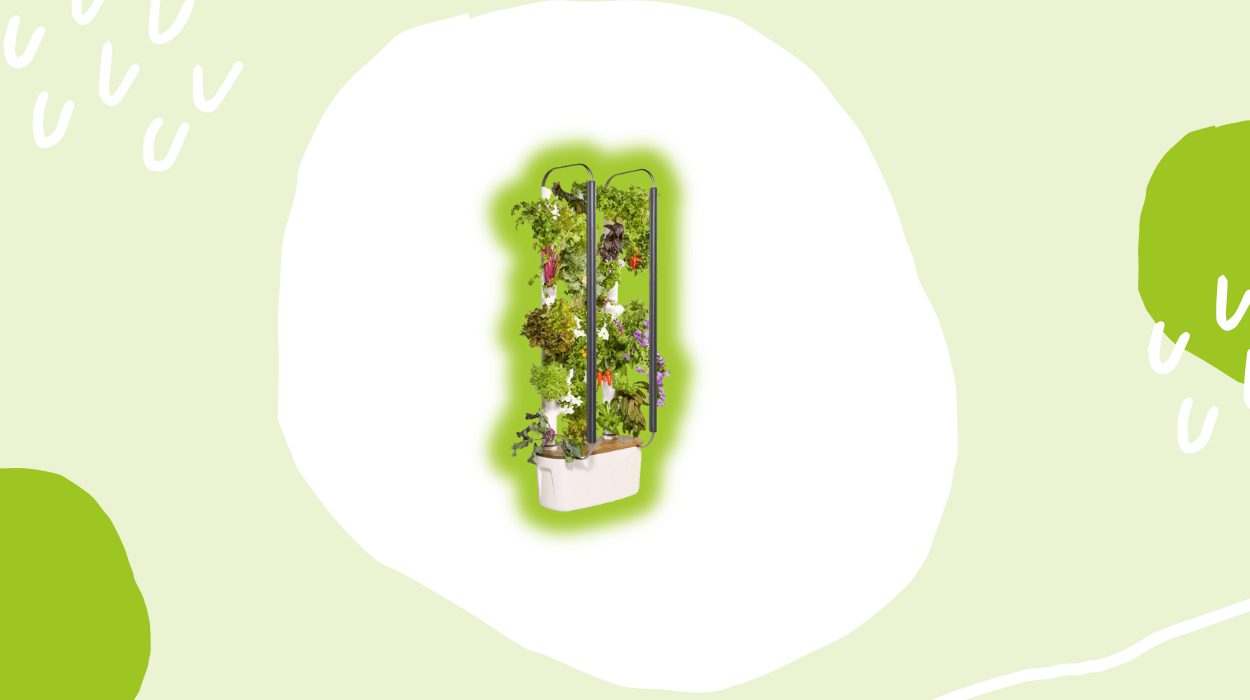

Gardyn is an indoor gardening brand that develops automated, soil-free systems designed to help you grow fresh produce at home. It offers vertical hydroponic units, which support the cultivation of herbs, leafy greens, vegetables, and select flowering plants throughout the year.
The brand also offers a proprietary seed pod library and optional services designed to support ongoing growing cycles. It features a controlled indoor setup that may help mitigate concerns related to weather variability, pest exposure, and access to fresh produce in urban settings.
This review will examine Gardyn’s product offerings, technological framework, and membership structure, along with its potential advantages and limitations. It will also consider cost factors and consumer feedback to provide a balanced assessment of the brand’s overall positioning and usability.
As per the official website, Gardyn focuses on enabling year-round indoor food production through automated, soil-free vertical systems. It combines physical growing units with app-based monitoring, AI-assisted plant care, and a recurring plant supply model.
The company’s primary products include Gardyn Home and Gardyn Studio, with Studio 1 and Studio 2 variations. Its Gardyn Home is designed for households of three to four people and supports up to 30 plants at a time. Meanwhile, Gardyn Studio is a smaller-format system intended for apartments or one to two people and accommodates up to 16 plants. Both systems use a vertical design that occupies approximately two square feet and integrate automated LED lighting and water scheduling to reduce manual input.
According to the official website, Gardyn offers more than 100 non-GMO plant varieties, including leafy greens, herbs, peppers, strawberries, and microgreens. Plants grow in proprietary pre-seeded pods known as yCubes. You can reorder plant varieties through the mobile app when rotating crops. The brand also emphasizes pesticide-free growing and promotes reduced transportation impact by positioning indoor harvesting as an alternative to long-distance grocery distribution.
The makers state that Gardyn also offers HydroBoost nutrient support, plant food, Sprout Nursery units, trellis supports, harvest kits, yCovers, ySleeves, replacement components, mobility bases such as the Gardyn Dolly, and bundled accessory kits.
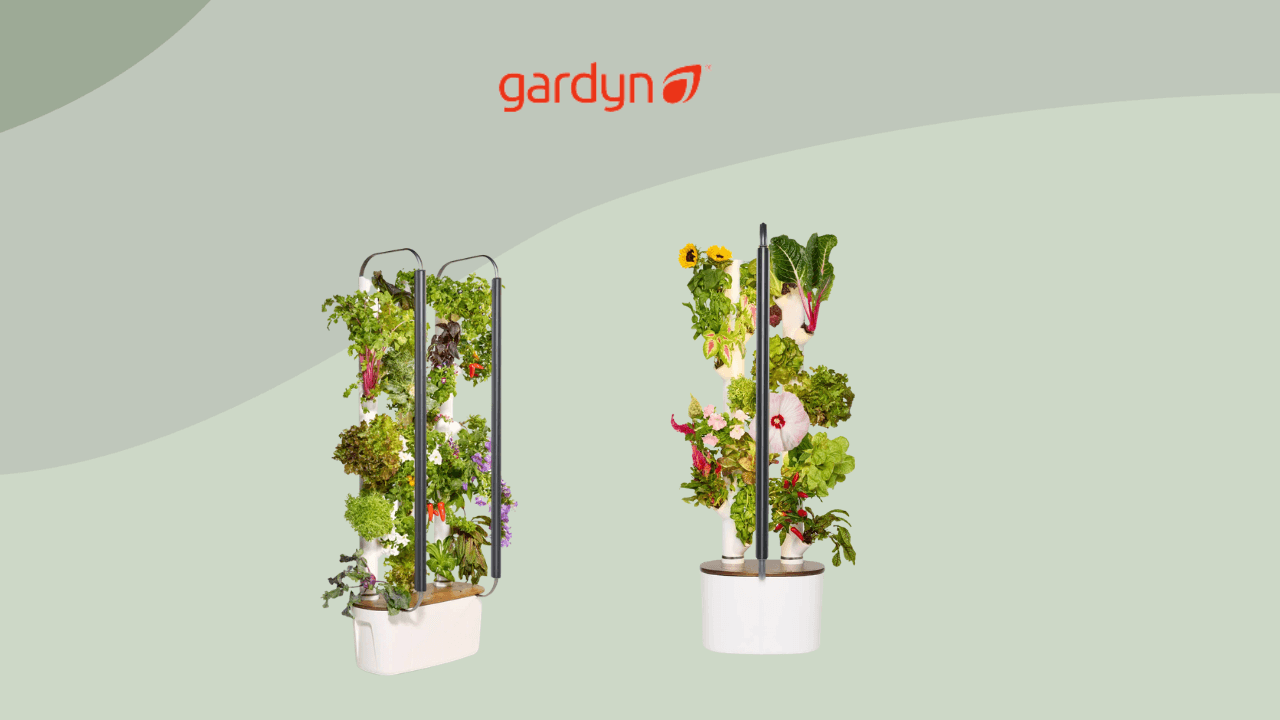
Gardyn Studio is a compact hydroponic system engineered to grow up to 16 plants within approximately 1.4 square feet of floor space. Its vertical design targets space-constrained environments such as apartments and kitchens, positioning it as an entry-level or secondary unit within Gardyn’s broader product ecosystem.
The system operates without soil, using a recirculating hydroponic reservoir (4+ gallon capacity) to deliver nutrients directly to plant roots. This configuration reduces mess, standardizes nutrient delivery, and lowers the variability associated with traditional container gardening. The closed-loop watering mechanism also improves water efficiency relative to conventional soil-based growing.
Studio integrates vertical full-spectrum LED grow lights programmed on automated schedules. This built-in lighting system enables year-round indoor cultivation independent of seasonal daylight availability. Seeds are housed in compostable yCubes with a rockwool-based medium designed for moisture retention and root aeration.
The Studio 2 iteration introduces redesigned columns with improved sealing and simplified cleaning, signaling incremental product refinement rather than structural reinvention. These updates align with brand messaging focused on usability and product durability.
Gardyn Home is designed to grow up to 30 vegetables, herbs, and leafy greens within approximately 2 square feet, effectively doubling plant capacity compared to the Studio model. Under typical growing conditions and depending on crop selection, Gardyn Home can yield an estimated 8 to 10 pounds of fresh produce per month. Output varies based on plant density, harvest frequency, and crop mix, but this yield range allows the system to supplement household grocery consumption.
The system integrates automated watering, full-spectrum LED lighting, and continuous plant monitoring. These built-in automation features reduce manual oversight and support consistent plant performance across growth cycles. Compared to traditional soil gardening, the hydroponic structure offers more predictable results in indoor environments. Gardyn Home also includes sensor and camera-based monitoring to track plant development and identify visible stress indicators.
Gardyn states that its system operates through an integrated ecosystem powered by the Kelby AI assistant. Built-in cameras and environmental sensors continuously monitor your plants, tracking water levels, lighting cycles, temperature, and humidity inside the unit. You receive real-time updates through the Gardyn mobile app, which gives you ongoing visibility into your garden’s performance.
The brand explains that time-lapse images and system data allow you to observe plant growth patterns and detect potential issues early. Instead of relying solely on visual checks, you can review recorded data and trends, which may reduce guesswork and give you clearer control over your indoor growing environment.
Gardyn also claims that Kelby generates personalized care plans based on what you are growing and each plant’s growth stage. The app sends notifications reminding you to refill water, add nutrients, clean the tank, check roots, harvest, and complete maintenance tasks. This structured guidance organizes your routine and may help you maintain more consistent plant performance over time. This structure can reduce daily oversight, simplify task management, and help you grow plants more confidently in a small indoor space while maintaining greater consistency in your harvest outcomes.
Gardyn states that you can grow food indoors without soil or direct sunlight. Its system uses a vertical hydroponic structure with reusable yCubes filled with nutrient-rich rockwool. Plant roots sit inside these cubes while water and nutrients circulate directly to them, creating a contained and soil-free growing setup.
A 4+ gallon internal tank supports a closed-loop watering system. According to the brand, this design uses up to 95% less water than traditional soil gardening. As water continuously recirculates rather than draining away, you may experience less water waste and a cleaner indoor environment without muddy residue.
Gardyn also explains that full-spectrum LED grow lights replace natural sunlight. These lights typically run automatically for about 12 to 16 hours per day, depending on plant requirements. The system is designed to mimic natural daylight cycles, which may help maintain steady plant development throughout the year.
You can grow herbs, leafy greens, vegetables, and select fruits inside a footprint of roughly 2 square feet. This compact size allows you to place the unit in a kitchen, apartment, or small living area without needing a yard or balcony.
The brand further claims that built-in pumps automate both watering and nutrient delivery. Water is distributed evenly across all plant columns, and the app alerts you when tank levels run low. Daily irrigation runs automatically, which may help reduce the risk of overwatering or underwatering.
This setup can reduce dependence on seasons and soil quality, simplify daily maintenance, and potentially provide more consistent, year-round harvests within a small indoor space.
Gardyn states that you can grow non-GMO plants without pesticides inside a controlled indoor system. As the unit operates indoors, it limits exposure to outdoor pests and reduces the need for chemical sprays. You decide what nutrients go into your plants, which may give you greater transparency over your food compared to many store-bought options.
The brand also highlights its reusable yCubes as part of a longer-term design strategy. Instead of discarding single-use pods after each cycle, you reuse the growing structure. Gardyn further notes that its packaging is recyclable. Compared to packaged grocery greens or disposable grow kits, this setup may help you reduce plastic waste in your home.
Gardyn positions home harvesting as a way to shorten the food supply chain. When you grow produce yourself, you bypass transportation, cold storage, and retail packaging. This may lower indirect environmental impact while allowing you to harvest greens as needed rather than purchasing pre-packaged quantities.
Gardyn connects much of its core functionality to a paid membership. After purchasing the hardware, which typically ranges from $500 to $1,300, you are required to maintain a subscription costing between $18 and $39 per month, depending on the plan length. For example, a two-year commitment lowers the cost to about $18 per month, while a month-to-month plan is closer to $39 per month. According to the brand, this subscription unlocks essential features such as Kelby AI guidance, automated app controls, plant credits for seed refills, notifications, and advanced system management tools.
Without an active membership, the system shifts into a reduced manual mode. While basic functions like low-water alerts remain available, you lose access to AI recommendations, automated reminders, plant credits, and advanced controls. This means you must handle lighting adjustments, watering oversight, and plant monitoring more independently. The experience becomes closer to a standard hydroponic setup rather than a fully guided smart gardening system.
The financial impact becomes more significant as annual subscription costs range from approximately $216 to $468, on top of the initial hardware investment. This recurring expense increases the overall cost of ownership and reduces flexibility compared to systems that operate without ongoing fees. This can directly affect your overall cost and experience. You pay more over time because the subscription adds to the upfront hardware price. If you cancel, you lose access to the smart features that make the system automated and guided, leaving you to manage most tasks manually and reducing the value of your initial investment.
Rise Gardens and Gardyn both operate in the indoor hydroponic gardening category, but they differ in system architecture, yield capacity, automation structure, and ownership model. As per their official website, Rise structures its product line around modular horizontal units, including The Rise Garden 3, The Rise Loft, and The Personal Rise Garden. The system is stackable, allowing you to begin with one level and expand up to three tiers. The brand highlights that each level accommodates between 16 and 36 plants, for a maximum capacity of 108 plants. It states that its system can produce up to 40 pounds of fresh produce per month under optimal conditions. On the other hand, Gardyn uses a vertical tower configuration rather than a stackable shelf design. It features Gardyn Home, which is described as growing 30 plants within approximately 2 square feet of floor space. The estimated yield is between 8 and 10 pounds of produce per month, depending on plant selection.
Rise claims that its design includes a patented gravitational watering system and full-spectrum LED grow lights intended to enhance photosynthesis. The Rise app provides structured guidance across growth stages, including transplant timing, weekly nutrient additions, and pH balance reminders. Alexa voice integration is also supported. Meanwhile. Gardyn’s system operates with automated lighting and watering, but differentiates itself through integrated cameras and sensors that continuously monitor plant growth. Its AI assistant, Kelby, provides refill notifications, plant care tasks, and personalized guidance through in-app chat support.
In terms of production capacity, Rise communicates higher maximum plant counts and greater monthly output potential. It also focuses on structured task reminders and modular expansion. In comparison, Gardyn communicates a lower total weight output but emphasizes space efficiency and automated oversight. It centers its differentiation on AI-driven plant monitoring supported by cameras and sensor-based diagnostics. Rise presents a scalable, higher capacity system with extended warranty coverage and larger water reservoirs. On the other hand, Gardyn presents a compact vertical system with an integrated AI monitoring structure.
AeroGarden operates under Scotts Miracle-Gro, placing it within a diversified lawn and garden portfolio that includes lawn food, grass seed, plant food, organic gardening, and indoor gardening solutions. On the other hand, Gardyn functions as an independent indoor growing brand, with its platform centered exclusively on vertical hydroponic systems, plant technology, and connected growing tools. AeroGarden, therefore, exists as one product line within a larger gardening corporation, while Gardyn’s business model is concentrated entirely on its indoor growing systems.
The two brands also differ in physical design and scale. AeroGarden primarily offers Harvest, Harvest Lite, Harvest XL, Harvest Elite, Harvest Elite 360, Sprout, Bounty, Bounty Basic, and Bounty Elite Stainless Steel. These systems are structured for kitchen counters and smaller interior spaces. Meanwhile, Gardyn offers freestanding vertical systems such as Gardyn Home and Gardyn Studio. These systems are designed to grow up to 30 plants simultaneously and support more than 100 non-GMO plant varieties.
Technology integration also presents another distinction. AeroGarden promotes a hydroponic system supported by built-in grow lights and pre-seeded pod kits. The process emphasizes straightforward setup and automated lighting. There is no reference to camera-based monitoring or AI-driven diagnostics on the brand’s official website. On the other hand, Gardyn combines a proprietary AI assistant called Kelby. With built-in cameras and sensors, Kelby monitors plants continuously, provides real-time alerts, assigns plant care tasks, and delivers guidance through Kelby Chat. This indicates a higher level of system monitoring and digital integration compared to AeroGarden’s more hardware-focused structure.
The planting formats also differ operationally. AeroGarden uses preseeded pods and offers a Grow Anything Seed Pod Kit, allowing you to plant your own selected seeds. Its product categories include Gardens, Seed Kits, Accessories, and Grow Lights. In comparison, Gardyn uses proprietary yCubes that are described as non-GMO and pesticide-free. The company references a 21 Day Sprout Guarantee and uses plant ordering through its website and app, where membership credits and plant refills are managed. This creates a more app-connected plant ecosystem relative to AeroGarden’s interchangeable seed pod approach.
There is also a difference in the visible price range of products across both brands. AeroGarden countertop systems range from $49.95 for the Sprout to $274.95 for the Bounty Elite models, with multiple Harvest variations positioned between approximately $99.95 and $139.95. In comparison, Gardyn’s listed accessory pricing ranges from $14.99 for options such as yPods and ySleeves to $269.94 for the Complete Accessory Bundle. Individual plant varieties such as Butterhead and Basil are listed at $4.99, while larger fruiting plants like Cucumbers and Cherry Tomatoes are listed at $9.98. This indicates that AeroGarden’s visible pricing centers on complete countertop units, whereas Gardyn’s shared pricing highlights accessories, plant refills, and bundled add-ons within its broader vertical growing ecosystem.
AeroGarden offers a countertop hydroponic option embedded within a large gardening corporation and structured around pre-seeded pods and grow light systems. Meanwhile, Gardyn presents a vertically oriented, sensor-enabled indoor growing system, app integration, continuous monitoring, and sustainability-centered messaging.
Gardyn operates within the premium, technology-integrated indoor gardening segment, combining automated lighting, watering systems, and app-based monitoring. The brand currently has an A+ rating from the Better Business Bureau, which generally reflects structured complaint handling, responsiveness, and adherence to marketplace standards. While a BBB rating does not measure product performance directly, it does provide insight into business conduct and dispute resolution practices.
Based on the available information, Gardyn appears to be a relatively young but operationally structured company within the smart indoor gardening category. Its continued product development and BBB rating suggest organized business practices and customer support processes. However, given its limited operating history, long-term performance stability can only be assessed over time.
To evaluate Gardyn, we analyzed 400+ Trustpilot reviews posted between 2022 and early 2026, analyzing product performance, subscription structure, replacement costs, and customer support.
Many users claimed the system performed well initially but developed hardware failures within one to two years. Several customers highlighted repeated pump breakdowns, WiFi connectivity issues, corrosion under the lid, and complete system shutdowns. Some also stated that because core components are integrated into the lid, minor failures require replacing the entire lid rather than a small, inexpensive part. A few customers highlighted replacement costs ranging from roughly $190 to $350, particularly after warranty expiration.
When evaluating the subscription model, many claimed that features they considered basic, such as water-level reminders and maintenance alerts, were locked behind a paid membership. Several customers highlighted confusion around auto-renewals and unexpected annual charges.
Some customers even claimed the AI assistant functioned primarily as scheduled reminders rather than advanced plant analytics, leading to dissatisfaction about recurring monthly or yearly fees. This recurring theme significantly influenced our cost-of-ownership analysis. Numerous claimed email support responses were delayed, while several customers highlighted difficulty reaching live phone support. Users also claimed chat interactions felt automated or unhelpful, and others described prolonged troubleshooting cycles. However, a few users highlighted positive support experiences, particularly when replacements were issued under warranty. This inconsistency influenced our overall reliability assessment.
Gardyn presents its system as water-efficient, pesticide-free, and space-conscious. However, the overall experience remains closely tied to its membership model.
While the hardware enables indoor cultivation independently, several advanced features, AI guidance, and plant credit benefits depend on an active subscription. This adds recurring costs beyond the initial purchase and affects long-term value.
Hydroponic systems require consistent monitoring of nutrient concentration, pH balance, sanitation, and lighting schedules. Without proper maintenance, issues such as algae growth, root disease, or plant stress can develop more quickly than in soil-based systems.
Gardyn combines established hydroponic science with automation and app-based management to deliver a structured indoor growing system. At the same time, ongoing subscription costs, electricity use, maintenance requirements, and reliance on a connected ecosystem represent practical limitations.
If you consider the system, it is important to account for these operational demands and the brand’s reliance on its subscription framework when determining overall cost and convenience.

Contact us at [email protected] or follow @leafsnap on Twitter! View our Privacy Policy.