
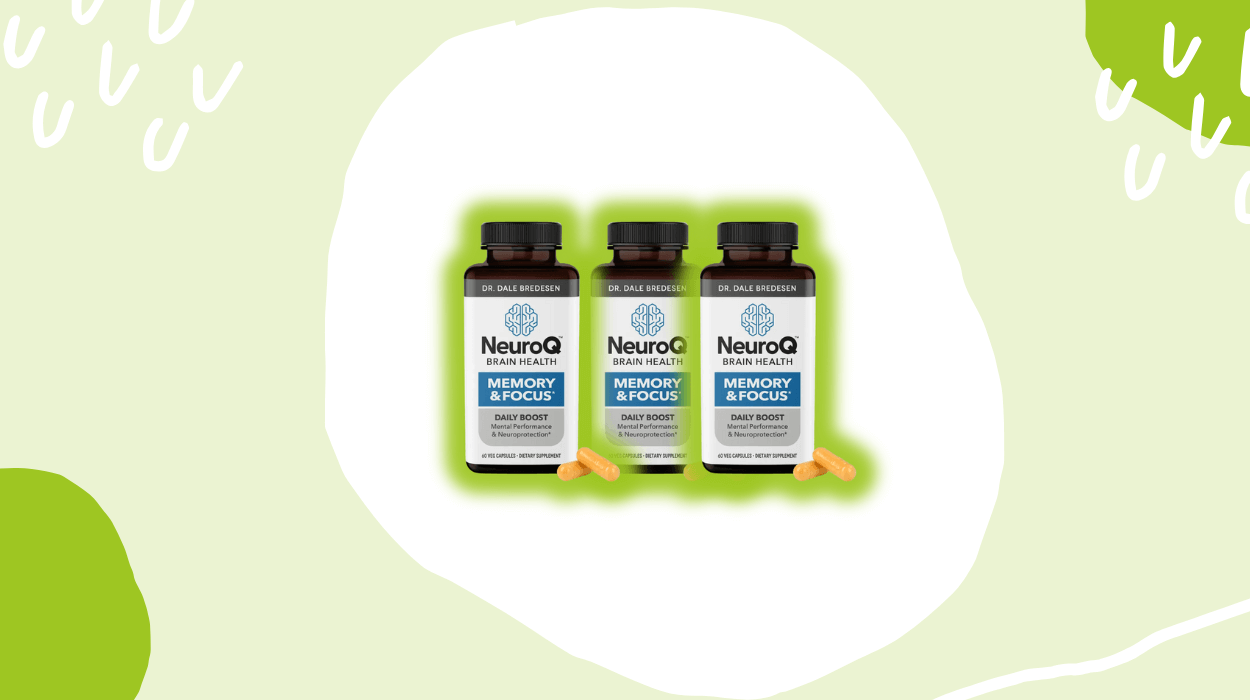

NeuroQ focuses on brain-support formulations to support memory, focus, learning, and overall mental quickness as you age. It claims to provide structured, evidence-aligned support for maintaining cognitive performance over time.
The brand highlights that its formulation may aid in supporting your neurotransmitter health, which could potentially boost your memory and recall ability.
In this review, we will examine NeuroQ’s philosophy, its scientific claims, and the mechanisms it uses to address cognitive aging. We will also evaluate the brand’s strengths and limitations while discussing feedback from real users to understand how its product performs in day-to-day use.
NeuroQ is a cognitive-health brand focused on clinically tested support for memory, focus, concentration, and retention. The brand frames age-related cognitive decline as partly unavoidable but significantly modifiable through targeted nutritional and lifestyle interventions.
The brand was developed with neurologist Dr. Dale Bredesen, MD, a leading researcher with more than three decades of experience studying neurodegenerative diseases at UCLA and the Buck Institute.
The core product, Memory & Focus, is engineered to support cognitive function. The brand highlights GMP manufacturing standards and quality-control measures but does not provide additional environmental claims.
The formulation label clearly lists key active ingredients, allergen information, exclusions (such as absence of milk, yeast, and corn), and capsule composition (hypromellose, silica, rice bran, ascorbyl palmitate).
The brand focuses on clinical credibility, regulatory compliance, and a straightforward delivery system with a neuroscience-driven approach.
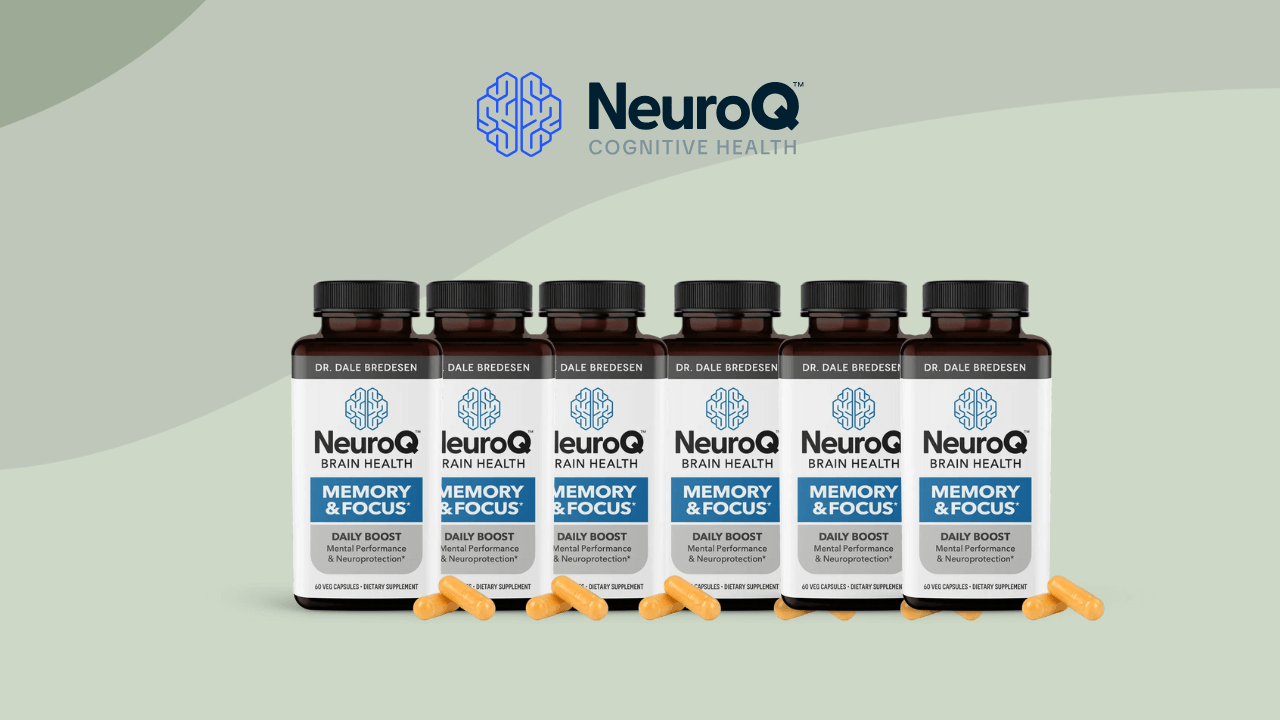
NeuroQ Memory & Focus may support memory accuracy, sustained focus, processing speed, and long-term cognitive resilience. The formulation is anchored around compounds that influence the acetylcholine system, the primary neurotransmitter pathway for learning, recall, and memory consolidation. Its component, Phosphatidylserine, is included for its ability to regulate membrane function in cholinergic neurons by supporting acetylcholine synthesis, enhancing receptor sensitivity, and improving membrane fluidity.
To reinforce neuronal structure and slow hippocampal deterioration, the Memory & Focus formulation contains botanicals known to influence neuroplasticity, synaptic remodeling, and neuronal repair. Gotu Kola provides triterpenoid compounds that activate pathways associated with dendritic branching, axonal stability, and synaptic reinforcement, strengthening the physical scaffolding required for memory formation.
The makers include coffee fruit extract for its ability to increase Brain-Derived Neurotrophic Factor levels, which may support the brain’s capacity to create new neurons, maintain synaptic connections, and reorganize neural networks to meet cognitive demands.
The formulation also contains Ginkgo biloba, which may help improve oxygen and nutrient delivery to cortical and subcortical regions. This vascular support contributes directly to sharper mental clarity, quicker cognitive responses, and reduced brain fog.
The formulation also targets chronic low-grade inflammation and toxin burden, two major contributors to neuronal degradation. Turmeric, rich in curcumin, modulates NF-κB signaling, suppresses pro-inflammatory cytokines, and reduces oxidative stress in neuronal tissues. Propolis in the Memory & Focus mix may add antioxidant and antimicrobial polyphenols that boost detoxification pathways and protect neuronal membranes from oxidative and inflammatory damage.
NeuroQ positions itself as a neurologist-developed brain-health brand grounded in the work of Dr. Dale Bredesen, whose 30 years of research in neurodegenerative disease and creation of the Bredesen 7 protocol provide a strong scientific framework for the product line.
Its primary formula, Memory & Focus, targets four contributors to age-related cognitive decline, such as reduced neurotransmitter activity, neuron damage, decreased brain blood flow, and inflammation caused by neurotoxins.
The multi-pathway approach, combined with Dr. Bredesen’s background at UCLA and the Buck Institute, differentiates the brand from general single-ingredient or multivitamin-style supplements.
This neurologist-backed structure means you are engaging with a brand that could support cognitive health from multiple angles rather than relying on a single mechanism. You could benefit from a formula built to support neurotransmitter activity, protect neurons, improve blood flow, and reduce inflammation, factors that directly influence memory and focus.
NeuroQ claims its supplements are made in United States facilities operated by LifeSeasons, Inc. in Kaysville, Utah, which follow Good Manufacturing Practices (GMP). These facilities maintain stringent oversight, including routine inspections, sanitation protocols, and production controls mandated for domestic nutritional supplement manufacturers.
Manufacturing in the USA may support NeuroQ's commitment to quality, transparency, and accountability through strong quality control systems. Domestic production also enables faster shipping times and more responsive customer service. This may help with quicker issue resolution and shorter lead times compared with offshore manufacturing.
NeuroQ promotes cognitive improvements that are not fully supported by strong, independent scientific data. Its scientific foundation relies on a single interventional, open-label, single-group clinical trial sponsored by LifeSeasons and conducted in collaboration with KGK Science. This study enrolled exactly forty adults aged forty-five and older who were identified as being at risk for cognitive decline, and it followed participants for 90-135 days.
Although the study was formally registered on ClinicalTrials.gov and followed a detailed protocol using validated CNS Vital Signs endpoints to assess memory, focus, processing speed, and broader cognitive performance, it remains an open-label design without a placebo or randomized comparator arm, which significantly limits interpretability.
There has been no independent replication, no large-scale follow-up, and no six- to twelve-month durability data. A small qEEG subset of ten participants provides only minor ancillary information that has not been publicly verified.
The protocol explicitly combined the NeuroQ product, taken as two capsules daily, with four lifestyle changes recommended in the Bredesen PreCODE framework. As the study included lifestyle-only and supplementation-only compliance subgroup analyses, it introduces unavoidable confounding that prevents attribution of any observed cognitive improvements solely to the product.
The formulation itself contains ginkgo biloba, phosphatidylserine, coffee fruit extract, gotu kola, turmeric, and propolis. While several ingredients individually show some supportive research for cognitive effects, the brand’s formulation as a whole has never been evaluated in large-scale, independent clinical trials.
Without disclosed statistical analyses, without effect sizes, and without independent scrutiny, NeuroQ’s evidence remains preliminary and insufficient for confidently substantiating bold performance claims.
NeuroQ’s marketing assertions, including the claim that 97% of users saw improvement, exceed what can be justified from a small, non-blinded, sponsor-funded trial with no peer-reviewed results, no replication, and no posted data.
The absence of long-term outcomes, the presence of lifestyle confounders, the lack of randomized controls, and the absence of publicly verified qEEG results all reinforce that the scientific support is limited.
Mind Lab Pro and NeuroQ both present themselves as scientifically grounded cognitive-support systems, but the structure of each brand shows two fundamentally different philosophies about what brain performance means and who each formula is built for.
The brand Mind Lab Pro positions itself as an advanced nootropic designed to optimize cognition across all ages and lifestyles, whereas NeuroQ defines itself as a doctor-led cognitive-aging program built solely around the causes of age-related mental decline.
Mind Lab Pro is focused on a broad functional thesis, which is that cognition can be optimized at any age through a clean-label matrix of eleven research-backed nootropics working across neurotransmitters, neural regeneration, cerebral circulation, neuroprotection, brain waves, and energy metabolism.
NeuroQ takes a narrow medical framework as its foundation, asserting that cognitive decline is driven by decreasing neurotransmitter activity, neuron loss in the hippocampus, reduced blood flow, and toxin-induced inflammation. Therefore, it is built specifically to counter those four decline mechanisms.
Mind Lab Pro focuses on supporting enhanced focus, clarity, memory, verbal fluency, creativity, and productivity, while NeuroQ is structured to slow, mitigate, or reverse decline-related deficits such as impaired recall, brain fog, slower processing, and reduced attention.
Both formulas support neurotransmitter function and neuroprotection, but their formulations reflect their philosophies. Mind Lab Pro uses Citicoline, Phosphatidylserine, N-Acetyl-L-Tyrosine, and L-Theanine to potentially boost brain energy, strengthen acetylcholine pathways, stabilize working memory under stress, and modulate alpha brainwaves for calm, productive focus.
NeuroQ uses Phosphatidylserine as a support, but pairs it with Gotu Kola and Coffee Fruit Extract to promote neuroplasticity and elevate BDNF for rebuilding neurons that decline with age.
The formulation of Mind Lab Pro includes Lion’s Mane Mushroom, Maritime Pine Bark Extract, Rhodiola Rosea, and NutriGenesis B6/B9/B12 to address neural regeneration, circulation, stress resilience, and homocysteine regulation. NeuroQ uses Ginkgo Biloba for blood flow and Turmeric (curcumin) and Propolis for inflammaging and toxin clearance.
Their scientific-validation strategies further separate the brands. Mind Lab Pro highlights its standing as the only nootropic formula with multiple double-blind, placebo-controlled human trials published in peer-reviewed journals, with documented improvements in processing time and recall. NeuroQ centers on a formula-specific KGK Science clinical trial showing that it may help with improved memory, focus, or concentration, tying the claim directly to Dr. Dale Bredesen’s decades of neurodegenerative-disease research.
Their formulation also reflects these differences. Mind Lab Pro uses a maximalist ingredient strategy but a minimalist additive philosophy, which is 100% clean-label, caffeine-free, non-GMO, gluten-free, synthetic-additive-free, using plant-based NutriCaps with fully disclosed clinical-range dosages. NeuroQ matches some of these standards, such as gluten-free, vegetarian, GMP-compliant, free of milk, yeast, and corn, but its ingredient list is shorter and directly tied to Bredesen’s four-cause medical framework.
Despite these differences, the brands share several similarities. They both claimed to be stimulant-free, science-led, transparent about ingredient dosages, and built to support long-term cognitive resilience. Both include botanicals with clinically studied cognitive effects and emphasize clean-label manufacturing and third-party testing. NeuroQ and Mind Lab Pro both of these brands aim to improve daily cognitive experience.
Mind Lab Pro is more focused on performance enhancement, productivity, focus, creativity, and broad-spectrum cognitive optimization. NeuroQ focuses on age-related cognitive slowing, memory loss, reduced recall speed, or alignment with a neurologist-led aging framework. Mind Lab Pro supports long-term brain health but does not explicitly target these decline mechanisms. It optimizes a healthy brain for higher performance, while NeuroQ supports an aging brain to maintain function and slow decline.
Trubrain positions itself as a performance-nutrition company built around high-performance superfuel formulations designed to elevate both cognitive and physical capabilities, grounding its identity in neuroscience, measurable outcomes, and the convenience of ready-to-use products. It centers on formulations created by UCLA-trained neuroscientists and validated through EEG measurement.
TruBrain focuses on cognitive optimization and clean metabolic energy. The brand aims to improve focus, motivation, mental clarity, learning performance, stress resilience, cerebral blood flow, and neuroplasticity through targeted nootropic blends. Its flagship 1-oz Drinkable Nootropics contain approximately 2,000 mg of natural nootropics per serving and are marketed to enhance focus, motivation, and blood-flow-driven cognitive performance. Ketone XL delivers 11 g of R-1,3-butanediol to induce rapid ketosis without dietary changes.
Surrounding these are Personalized Drinks, Nootropic Capsules, Morning Mushrooms, Daily Greens, Daily Hydration, Brain Aging formulas, Powder Sticks, a Coffee Kit, and curated bundles, all positioned as components of a cohesive, high-performance toolkit.
Against this performance-driven identity, NeuroQ focuses on a fundamentally different narrative rooted in clinically grounded cognitive-aging support led by neurologist Dr. Dale Bredesen, MD.
Rather than optimizing high performance, NeuroQ focuses on slowing or reversing age-related decline, stating that aging naturally reduces neurotransmitter levels, neuron density in the hippocampus, cerebral blood flow, and toxin clearance, but that the pace of decline can vary dramatically depending on targeted support.
Its framework is built around four biological drivers of cognitive decline, which are reduced acetylcholine and other neurotransmitters, hippocampal neuron loss affecting memory formation and retrieval, diminished blood flow impairing focus and processing speed, and toxin accumulation with chronic inflammation (“inflammaging”), reducing cognitive capacity.
NeuroQ’s formulation strategy is therefore oriented around intervention rather than enhancement. Its Memory & Focus formula is presented as a targeted option to help manage these four decline pathways.
While TruBrain builds a broad nootropic and ketone ecosystem across capsules, powders, shots, and bundles, NeuroQ focuses on a tighter, medically curated formula complemented by Dr. Bredesen’s Cognitive Health Program and the Doctor’s Guide to Brain Health, which provide lifestyle and nutrition guidance that aligns with long-term cognitive-aging prevention.
TruBrain’s nootropic stacks and ketone fuels emphasize rapid cognitive acceleration and clean metabolic energy, whereas NeuroQ’s botanical and neuroplasticity-oriented approach emphasizes sustainable cognitive preservation.
Both brands share commitments to clean formulations, long-term brain health, neurotransmitter support, neuroprotection, and educational content, but the similarities stop at high-level principles. TruBrain operates as a performance-engineering platform built for users seeking more output, greater efficiency, and extended cognitive stamina. NeuroQ operates as a clinical aging-intervention brand designed to slow decline, maintain independence, improve recall, and restore clarity. TruBrain’s narrative is built on EEG insights and neuroscientist-driven performance metrics; NeuroQ’s is built on neurology, Bredesen-protocol research, and formula-specific clinical validation. TruBrain’s proposition is acceleration; NeuroQ’s is preservation.
TruBrain is appropriate for performance optimization, clean metabolic fuel, sharper focus, and enhanced cognitive output during demanding tasks. NeuroQ claims to provide support for memory, focus, and long-term cognitive resilience. Both are brain-health brands, but they operate in different cognitive goals, where TruBrain is engineered to build a faster brain, and NeuroQ is designed to protect an aging one.
While evaluating real user experiences for NeuroQ, we looked for what users shared about their experiences on Amazon. The reviews for Memory & Focus reflect a generally positive customer response, with a 4.2 out of 5 average rating across 1,860+ global reviews.
Many users report clearer thinking, better concentration, improved alertness, and a sense of mental sharpness when taking the product consistently, with potential improvements in daily cognitive tasks. Some say the product works as intended but not strongly enough to justify the price, while others report that initial improvements tapered off or remained subtle after continued use.
A significant number of customers consider Memory & Focus overpriced relative to its results. Some report no noticeable cognitive improvement even after multiple months of use, and some mention side effects such as headaches, digestive discomfort, diarrhea, or mixed changes in urinary frequency.
The overall experience of users on Amazon shows that the brand’s product works well for many people, particularly those who use it regularly, but its impact varies widely, with a notable portion of users experiencing minimal changes or tolerability issues.
LifeSeasons, the parent company of NeuroQ, holds a moderately positive but mixed brand reputation marked by both credible operational history and recurring customer-service issues. The company is not accredited by the Better Business Bureau, though it maintains an A rating, and its BBB record lists some complaints over the past years.
The nature of these complaints centers on subscription-management challenges, delayed or disputed cancellations, refund frustrations, and difficulties reaching customer support. Several customers report that multiple follow-ups were required before a resolution was provided, and confusion over refund windows and cancellation terms appears repeatedly.
While the BBB data does not indicate severe misconduct, the consistent patterns of subscription friction and communication gaps suggest that the customer experience can vary meaningfully.
LifeSeasons’ reputation reflects a brand with a stable operational foundation and generally responsive but sometimes inefficient customer service, indicating that while the company is not untrustworthy, you should approach subscriptions and cancellation policies with measured caution.
NeuroQ offers a neurologist-led approach to cognitive support that may appeal if you want a formula anchored in age-related brain health. Its approach focuses on neuroprotection, cerebral blood flow, and inflammation. The brand claims to support clarity, recall, and everyday mental sharpness.
The scientific foundation, however, is narrow and early-stage. The only study supporting NeuroQ’s formula is a small open-label trial with no control group, no long-term follow-up, and no independent replication.
As lifestyle modifications were included in the protocol, the results cannot isolate the contribution of the formulation itself. Some ingredient doses are also below levels used in stronger clinical research, making it difficult to determine how closely the formula’s effects align with published data.
NeuroQ may be a fit if your priority is looking for a cognitive-aging support brand with a structured rationale and clean-label manufacturing standards. At the same time, its limited clinical validation and reliance on ingredient-based reasoning mean expectations should remain measured.
It is best to consider the formulation as a potentially supportive option rather than a clinically proven intervention, and to evaluate how well the brand aligns with your goals, budget, and long-term cognitive-health plan.

Contact us at [email protected] or follow @leafsnap on Twitter! View our Privacy Policy.