



Titan claims to provide structured access to testosterone replacement therapy through a fully online care model. It focuses on symptoms commonly linked to low testosterone, such as low energy, reduced physical strength, decreased libido, and difficulty maintaining focus.
The brand’s core offering combines at-home lab testing, virtual clinician consultations, and prescription-based plans. It aims to support improvements in energy, physical performance, and daily functioning within a monitored care framework.
In this review, you will explore the brand’s core offerings in detail. The analysis also examines potential limitations and what real users report about their experience, helping you evaluate whether the brand aligns with your expectations and fitness goals.
According to the official website, Titan works through a telehealth model that combines lab testing, online clinician visits, and prescription testosterone medications shipped directly to you in discreet packaging.
The platform centers its services on symptoms linked to low T levels, rather than offering a wide range of products. The brand’s main category is men’s hormone care, with TRT as its primary service. It highlights that all its medications are prescription-based and sourced from U.S.-licensed pharmacies after a clinician review.
As per the official website, the process starts with a short online assessment that asks you to rate symptoms related to energy, mood, focus, body weight, muscle changes, sexual health, and digestion. You then complete a blood test that checks more than 12 biomarkers, including testosterone and other markers tied to male health.
After results are available, you meet with a licensed clinician online to review your lab data, symptoms, and goals. If you qualify, Titan provides access to medications with ongoing clinician check-ins and automatic refills. The brand highlights features such as unlimited clinician access and guaranteed on-time refills.
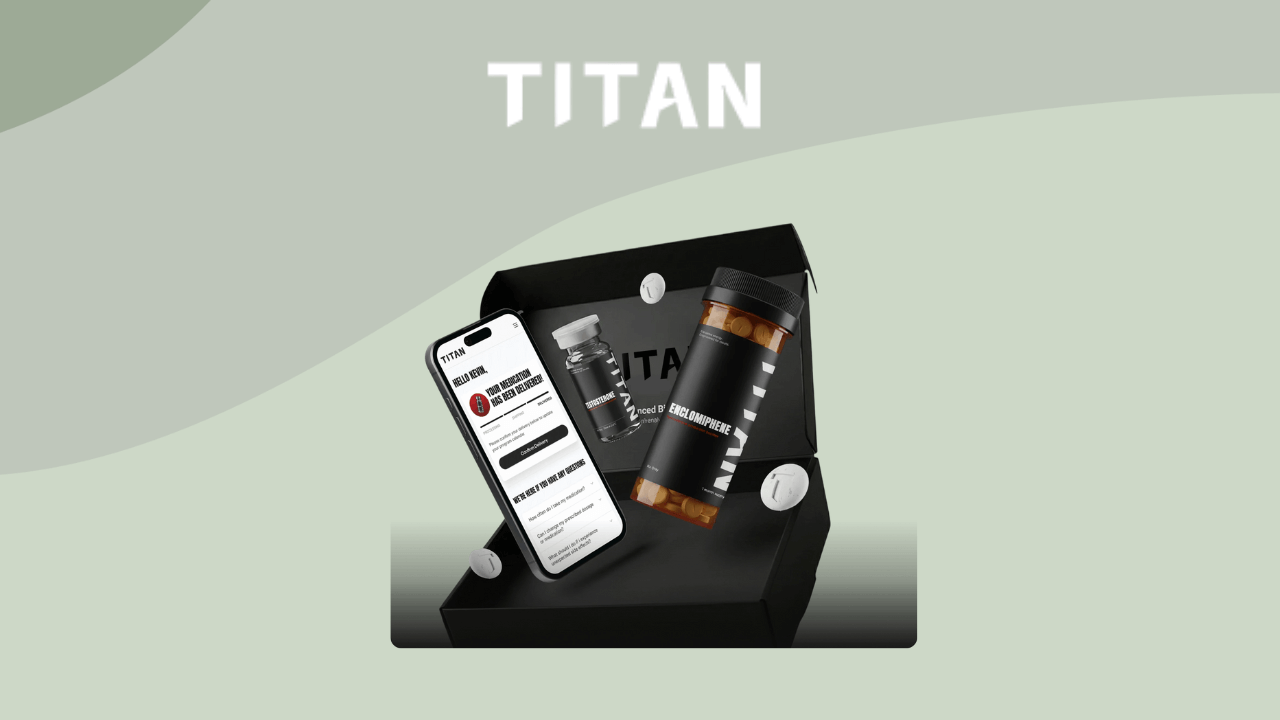
Testosterone Replacement Therapy at Titan is offered as a clinician-prescribed plan for men with laboratory-confirmed or clinically evaluated low testosterone. If considered appropriate after reviewing your lab results, symptoms, and clinical history, Titan offers several options. These include oral T formulations and enclomiphene. Unlike direct testosterone replacement, enclomiphene acts on the hypothalamic–pituitary–gonadal axis by selectively blocking estrogen receptors in the hypothalamus. This reduces estrogen-mediated negative feedback, leading to increased luteinizing hormone and follicle-stimulating hormone secretion, which helps stimulate endogenous testosterone production by the testes.
When clinically indicated, anastrozole may also be included at no additional cost. Anastrozole inhibits the aromatase enzyme responsible for converting testosterone into estradiol, which can help manage elevated estrogen levels that may occur during testosterone optimization and support hormonal balance.
As per the official website, the plan is personalized and offered without a long-term commitment. Titan does not accept insurance, which the brand states allows for faster access to care, transparent pricing, and fewer administrative constraints. Required laboratory testing can be completed through an at-home kit or at partnered facilities such as Labcorp, Quest Diagnostics, or BioReference, with results sent directly to Titan for review. Once lab results are available, you consult with a licensed clinician online to assess eligibility, determine the appropriate option, and establish dosing.
Titan does not name a medical advisory board or explain who designs and updates its clinical protocols. It does not describe compliance standards outside of licensing requirements. The brand also does not outline quality checks, case review schedules, or plan audit processes. This lack of detail limits your visibility into how care quality is maintained, leaving you to rely more on brand statements than documented oversight. In a regulated category, limited transparency can slow your trust and reduce the brand’s appeal if you expect clear governance and accountability.
Titan does not provide you with access to detailed performance data, such as user outcome summaries, procedure success rates, or long-term adherence results. The brand also does not share customer retention figures, average duration, or comparisons with similar telehealth platforms. This means you’re left to evaluate the service mainly through testimonials, reviews on platforms like Trustpilot, or broad brand statements rather than measurable metrics. This lack of data limits your ability to independently verify effectiveness, and in a regulated telehealth space, it can raise caution and slow adoption.
Fountain TRT and Titan both operate as fully online platforms, but they differ in how they structure care, define plan scope, and present clinical oversight. As per their official website, Fountain TRT frames low testosterone primarily as an age-related condition that is often overlooked, emphasizing access to specialist-led evaluation and restoration of testosterone to a healthy range. Titan, in comparison, positions TRT within a broader hormone optimization framework, emphasizing performance outcomes, speed of access, and medication flexibility.
The platforms have some differences in terms of the plan format. Fountain TRT limits its offering to a single topical testosterone cream. This approach is consistently positioned as a convenience-driven alternative to traditional TRT methods. Meanwhile, Titan offers a wider range of clinician-prescribed options, including TRT in different formats and enclomiphene. This allows Titan to accommodate varying clinical needs, delivery preferences, and fertility considerations rather than anchoring the plan to one administration method.
Differences also extend into diagnostic depth and testing logistics. Fountain TRT begins with a short symptom-based assessment followed by blood testing through partner laboratories, with results reviewed by a Fountain physician and explained through secure communication and telehealth. Titan places greater emphasis on biomarker analysis, using comprehensive lab panels that measure more than 12 biomarkers. It also offers flexibility in testing methods, allowing you to choose between at-home testing kits or in-person testing at Quest or Labcorp locations.
The consultation and follow-up structure also differs in emphasis. Fountain TRT relies on scheduled telehealth video visits for evaluation, decision-making, and ongoing monitoring, with follow-up visits typically occurring every three to six months as part of its membership. Titan emphasizes continuous clinician access rather than fixed follow-up intervals, framing ongoing support around availability and responsiveness.
Fountain TRT operates as a narrowly focused, urologist-led platform centered on topical TRT and simplified care delivery. On the other hand, Titan functions as a broader, data-driven hormone optimization service offering multiple medication pathways, faster onboarding, and expanded hormone management options.
PeterMD positions itself as a comprehensive men’s health and longevity platform. On the other hand, Titan is built around a narrow, TRT-focused care model. This distinction suggests how each brand structures its offerings, diagnostics, pricing, and long-term engagement.
PeterMD covers a wide range of fitness categories, including testosterone optimization, medical weight loss, sexual wellness, performance enhancement, hair loss, and longevity support. Its approach treats TRT as one component within a broader health ecosystem that also includes GLP-1 medications, peptides, thyroid optimization, sexual performance drugs, hair restoration products, and NAD+-based longevity protocols. In comparison, Titan concentrates almost exclusively on testosterone replacement therapy, with messaging and services centered on supporting healthy testosterone levels rather than expanding into adjacent categories.
Both brands offer clinician-prescribed TRT, but their plan structures differ. PeterMD provides oral TRT and HCG, positioning these options within long-term optimization programs. Titan also offers TRT in different formats, but distinguishes itself by including enclomiphene as a fertility-friendly alternative and anastrozole at no extra cost when clinically appropriate to manage estrogen levels.
Diagnostics represent another major point of contrast. PeterMD places heavy emphasis on extensive lab testing, offering multiple panels that range from 30+ to 129 biomarkers. These panels assess hormones, metabolism, inflammation, nutrient status, organ function, and long-term health risks. Meanwhile, Titan takes a more streamlined approach, focusing on lab panels that measure 12+ key biomarkers primarily related to testosterone and hormonal health, aiming to reduce complexity while maintaining clinical relevance.
The lab collection process also differs. PeterMD relies on in-person, clinical-grade blood draws conducted at Quest or LabCorp locations and avoids at-home testing kits altogether. Titan allows you to choose between at-home lab kits or visits to Quest or LabCorp, prioritizing convenience and faster onboarding. This flexibility supports Titan’s promise of starting the process in as little as five days.
Pricing and entry structure further highlight their different positioning. PeterMD uses tiered pricing based on commitment length. The month-to-month plan costs around $139 per month. A six-month plan lowers the price to $119 per month, billed upfront at $714 total. The twelve-month plan offers the lowest rate at $79 per month, billed upfront for $948 total. Titan follows a low-barrier entry model that allows you to start for $49, which includes blood work, a clinician consultation, and a personalized plan. The brand emphasizes flexibility over long-term packages, noting there is no ongoing commitment and that continuation depends on lab results, symptoms, and clinical evaluation.
Technology and tracking capabilities also differ. PeterMD promotes a dedicated app that supports hormone tracking, body composition mapping, and diet and exercise planning. On the other hand, Titan does not highlight an equivalent digital health platform. Instead, it focuses on direct clinician access, refill reliability, and medication delivery.
PeterMD focuses on a comprehensive, data-driven approach that extends beyond testosterone into weight management, longevity, and preventive care. Meanwhile, Titan features a simplified and fast pathway to TRT, with fewer moving parts and a lower upfront commitment.
Titan operates as an online health service centered on testosterone replacement therapy, offering remote lab testing, virtual clinician consultations, and ongoing prescription fulfillment through U.S.-licensed pharmacies. The service is positioned as a subscription-based, end-to-end program rather than a single consultation or test. However, established credibility signals such as BBB listings, industry coverage, or long-standing business registry records are notably absent, making it difficult to assess brand age or operational history outside of its own claims.
We also assessed Titan’s broader online visibility to understand how it is discussed by users in independent spaces. There is no meaningful presence or conversation about the brand on platforms such as Reddit or Tenereteam, where customers typically share real-world experiences, concerns, or long-term outcomes. Our evaluation indicates that Titan currently lacks the depth of brand history, independent validation, and volume of user feedback that typically support higher confidence in an online healthcare service.
To evaluate Titan, we reviewed its Trustpilot feedback from 2025, which includes two customer reviews posted in October and November 2025. With such a limited number of reviews, the brand’s Trustpilot rating of 3.4 is based on very little user feedback.
One review raises clear concerns about pricing and billing. The user states they were charged a recurring $250 membership fee every 28 days and says this cost was not clearly explained at the time of sign-up. The review also mentions problems with cancellation, claiming the cancel option in the user portal did not work. These points suggest that pricing details and account controls may not be communicated clearly, which can create frustration if charges continue unexpectedly. While the company acknowledged dissatisfaction related to billing, it did not directly address the reported cancellation issue or explain how pricing is shown during enrollment.
Another user stated that they were happy with the results provided. However, the comment does not explain what worked well or which part of the service led to that outcome, limiting how useful the feedback is for evaluating service quality. With such limited feedback, the reviews reflect individual situations rather than a consistent pattern. They should be viewed as personal accounts, not as a reliable measure of how the service performs for most users.
Titan positions its service around providing clinician-guided support. However, it does not publicly outline how its clinical protocols are established, how frequently they are reviewed, or are aligned with evolving clinical guidance. This means you will have limited visibility into how care standards are maintained and applied consistently.
The brand does not disclose process success rates, adherence data, or long-term outcome reporting. Given that testosterone therapy often requires ongoing monitoring to assess both effectiveness and physiological impact, the absence of published longitudinal data can restrict your ability to independently assess performance beyond clinician input and user feedback.
Before using the platform, it is essential to clarify the scope and limits of its monitoring practices. You should confirm follow-up testing frequency, understand which biomarkers are tracked alongside testosterone, and ask how plan adjustments are managed over time.
Titan’s focused model may be suitable if you are seeking a streamlined service, but its limited disclosure around protocols, outcomes, and oversight represents a structural limitation that needs careful consideration.

Contact us at [email protected] or follow @leafsnap on Twitter! View our Privacy Policy.